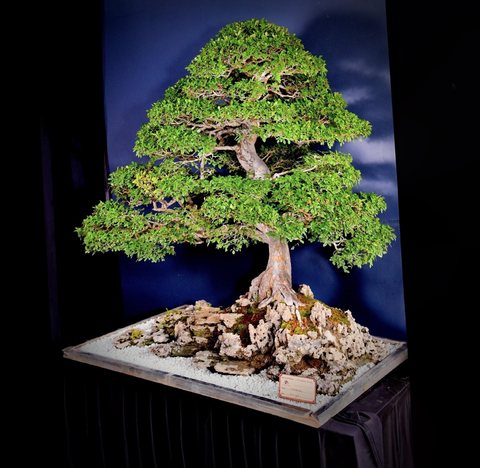
"Gone with the Wind" The Windswept Style and a Tale of a Dying Bonsai Club
The authors explain techniques for creating a natural windswept bonsai style through phototropism, including tree positioning and directional growth, inspired by naturally windswept live oaks in Texas.
July 1, 2025
By David WhitakerPublished in: BCI Bonsai & Stone Appreciation Magazine 2025 Q3
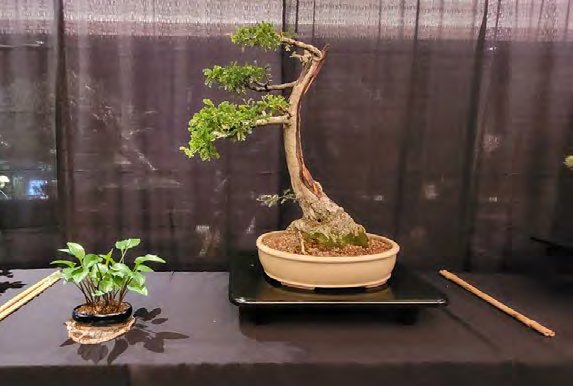
As a young kid, my family would often take weekend fishing trips to the “Coast.” We would stay at the Sea Foam Motel next to the Fulton Mansion in Fulton, near Rockport, Texas. This is where you’ll find some of the most beautiful naturally windswept live oaks. Those trees remain my inspiration whenever I am working on a windswept-style bonsai.
Realistically accomplishing and maintaining a windswept-style bonsai is a difficult task. Achieving fine ramification, selective pruning, trimming, and wiring are key to developing a convincing windswept bonsai. There’s an additional technique I use to accomplish the windswept look—with the help of Mother Nature. All plants grow upward toward the sun regardless of how much or how little sun they receive (phototropism). The windswept style intends to create the illusion of wind always blowing on the tree from one direction. As such, you want to position the potted tree at an angle with the windswept direction facing the sun. After a while, this method will accomplish a more natural look than one achieved solely by trimming and wiring. I achieve the best results by placing the windswept direction facing due south (in the Northern Hemisphere) and propping it up at a 30- to 45-degree angle to get the best sunlight. This also encourages desirable new growth from the underside of the branches. Ideally, I would follow the rising and setting sun, but I have better things to do—and other trees to tend to!
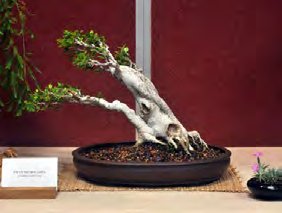
I’m able to position the tree at a 30- to 45-degree angle by placing wooden wedges underneath the pot. Here in South Texas, facing the pot due south and propping it upward allows for maximum exposure to sunlight all day, eliminating the need to move the plant around following the sun.
Watering requires setting the pot flat until the water has drained out. After that, the tree goes back to its angled position, and you let the sun “maintain” your windswept bonsai.
We live in a naturally windy zone of the U.S. On days that are not as windy, it may be helpful to prop up the “low end” of the pot overnight to help it dry out and prevent root rot. In the morning, the tree goes back to its original angle with the “high end” facing the sun. Always check both ends of the pot for moisture to prevent root rot. Periodic applications of fungicide and annual repotting with fresh soil are good measures to further prevent root damage.
While trimming and wiring are still necessary for major shaping, using “solar power” to assist with development and maintenance is an easy way to grow your windswept trees!
Living strategically between San Antonio and Corpus Christi has offered me the privilege of interacting with the bonsai communities of both cities (roughly 120 miles apart). While the San Antonio Bonsai Club has enjoyed a thriving membership and is active year-round in the community, the Corpus Christi Bonsai Club began experiencing a steady decline in membership and engagement over the last 10 years. The final nail in the coffin came in the form of the 2020 COVID pandemic and lockdown. By the time activities resumed in 2022, the club membership had dwindled significantly. Monthly meetings were attended by only a handful of members—most of them belonging to the club’s board of directors. At one point, serious consideration was given to permanently suspending activities and dissolving its nonprofit status.
Fast forward to 2023, when one of us (Jorge Mendizabal) took on the task of club president of a 40-year-old, dying organization. The mindset from the beginning was to revamp the monthly meetings by introducing hands-on workshops rather than continuing with the outdated lecture/demo format. With the assistance of a new and dynamic board of directors, the club added exhibits and demonstrations at local nurseries and at our local botanical garden. These activities were accompanied by membership drives. Within the first quarter of 2023, our club added around 70 new members. At least a third of those were acutely infected with the “bonsai bug” and became regular attendees at our monthly club meetings.
By 2024, with a new president on the board (David Whitaker), the new board of directors began an aggressive social media marketing campaign. The club’s logo was redesigned. Social media presence was energized. The club developed merchandise. Along with the San Antonio Bonsai Club, we accepted the challenge of organizing the statewide convention of the Lone Star Bonsai Federation in 2025.
We are happy to announce that the Corpus Christi Bonsai Club is alive, thriving, and sailing along with the new millennium. Our goal remains unchanged: to educate and promote the art of bonsai in South Texas and the Texas Coastal Bend.