
Lingnan Masters Gather at Baowen Garden to Explore the Artisan Heritage of Lingnan Bonsai
By Guangzhou Baowen Gardens · May 28, 2026
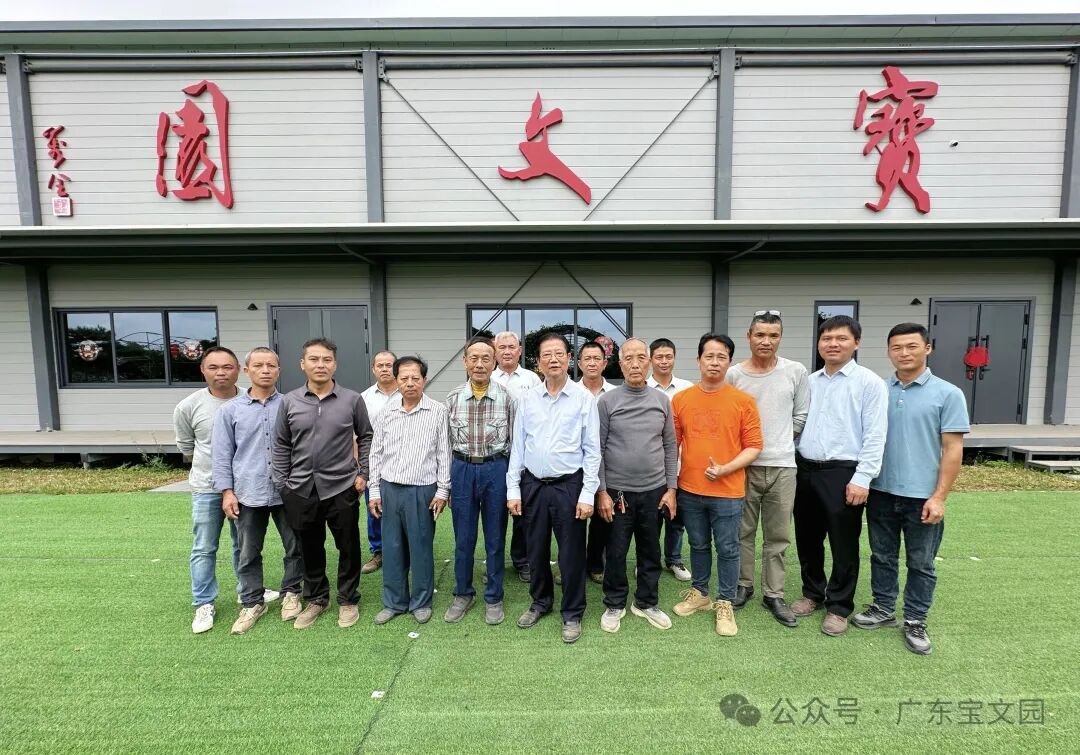
On the eleventh day of the first lunar month in the Bingwu Year of the Horse, with spring rain moistening the fields and the Awakening of Insects approaching, the world turns warmer and farming gradually becomes busier. Deng Kongjia, Lifetime Honorary President of the Guangdong Penjing Association; Guangdong Lingnan penjing art masters Chen Wanjun, Chen Jiajin, and Xian Jiaju; and renowned Lingnan penjing artist Yuan Qirui, driven by their passion for and desire to explore Lingnan penjing art, made a special visit to Baowen Garden. Together with the Baowen Garden team, they appreciated penjing, discussed techniques, and promoted exchanges, embarking on a penjing art exchange journey that was both professional and enjoyable.
BCI President and Baowen Garden owner Chen Chang personally received the visiting guests. BCI China Vice President Chen Zhaonian, Secretary-General Xu Dongting, BCI China penjing master Luo Zhijie, Li Wencai, and Baowen Garden senior technicians Du Jiankun, Xu Xiping, Zhong Zhiyong, and Guo Shaobo accompanied them throughout, jointly participating in this technical exchange activity. The atmosphere was warm and harmonious.
Stepping into Baowen Garden, one is greeted by a dazzling array of collections spanning ancient and modern, Chinese and foreign, with everything one could wish for. The well-arranged penjing exhibits come into view: the bright red of bougainvillea, the vigorous strength of Ficus microcarpa, the rustic simplicity of Chinese hackberry, the uprightness and character of pines and cypresses, and the wild charm and liveliness of miscellaneous trees. Each piece embodies both natural charm and humanistic craftsmanship. The garden owner's team strives for neatness and uniqueness in the works, which aligns with the philosophy of Foshan and Jiangmen penjing enthusiasts who emphasize "distinctive variety characteristics, artistic forms not confined to one style, and keeping up with modern penjing trends." This instantly ignited the visiting artists' enthusiasm for exchange. During the exchange, the masters did not stop at mere appreciation and admiration but engaged in in-depth discussions on the appreciation angles and styling designs of each penjing work. They expressed their own views freely and shared their years of creative experience and aesthetic concepts without reservation.
In front of a uniquely shaped forest-style penjing of Premna microphylla, the artists agreed on the appreciation and creation approach of "balancing the primary and secondary, and integrating the real and the virtual." They unanimously recognized that the overall penjing presented a sense of layering that is "sparse but not empty, dense but not crowded." The masters, combining the traditional Lingnan penjing technique of "trunk chopping and branch growing," emphasized that Lingnan penjing stresses "shrinking the dragon into an inch, seeing the large in the small," and highlighted the importance of innovation based on Lingnan penjing traditions, so that works possess both traditional charm and modern aesthetics. Drawing on their own creative experiences, the artists shared how to absorb modern aesthetic tastes and trends, innovate expressive styles, and adjust branch density so that the penjing presents the best visual effect from different viewing angles, with every detail showcasing artistic ingenuity. Some good stump materials even sparked creative ideas among the artists, leading to intense collisions and debates over different artistic conceptions. The final plan, which sought common ground while reserving differences, pleased everyone.
BCI President and Baowen Garden owner Chen Chang, who listened attentively to the masters' suggestions throughout, deeply agreed with their professional insights and occasionally exchanged his own creative ideas with them. Witnessed by the masters on site, President Chen Chang immediately decided to carry out a disruptive on-site transformation of a kapok penjing and several other works with room for optimization. Incorporating the masters' suggestions, he adjusted the layout, thinned and pruned branches, and repeatedly refined details, striving to achieve a more perfect artistic effect. This reflected President Chen Chang's artistic attitude of inclusiveness, truth-seeking, and pragmatism. President Chen Chang also stated that Baowen Garden has always been committed to the inheritance and innovation of Lingnan penjing, and the nearly ten thousand penjing in the garden are waiting for visits from domestic and international art masters. He welcomes everyone to discuss and exchange ideas. Baowen Garden welcomes "penjing enthusiasts" and experts from related industries with a passion for penjing to visit, to collide in technical inspiration, exchange advanced aesthetic concepts, and, based on penjing creation practice, jointly explore ways to break through the development bottlenecks and pain points facing the penjing and viewing stone industry.
The on-site technicians also observed and learned throughout the entire process, meticulously recording the masters' key guidance points and Chairman Chen Chang's creative concepts and techniques, and through practice, they grasped the artistic essence of Lingnan bonsai. This discussion not only refined the styling of several bonsai works, making their charm more prominent, but also allowed everyone present to experience the allure of bonsai art—'constantly striving for perfection and continuous refinement.'
This bonsai appreciation session with the masters lasted over three hours, and everyone was so captivated that they were reluctant to leave the bonsai garden even when lunchtime arrived. This visit and exchange not only built a platform for skill sharing but also promoted the exchange and inheritance of Lingnan bonsai art, allowing traditional bonsai techniques to gain new vitality through interaction. It has also injected new ideas and vitality into the future bonsai creation and development of Baowen Garden.