
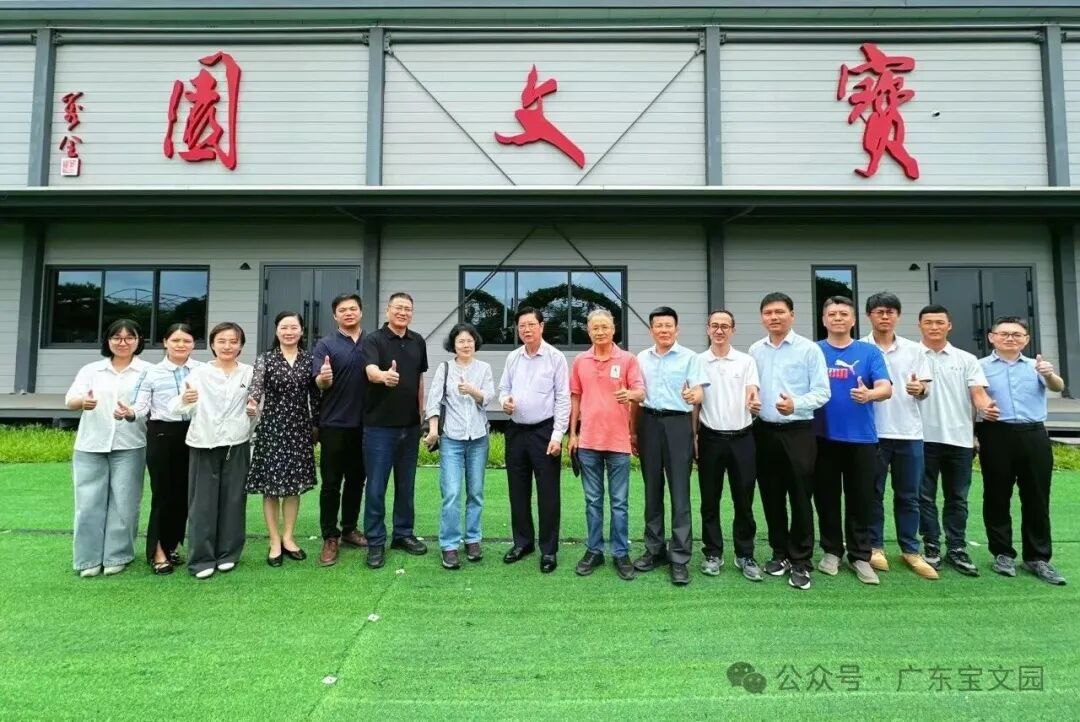
Jointly promoting the industrialization of bonsai, bringing the 'vessel of the Dao' into thousands of households—Guangzhou Forestry and Landscape Bureau research team conducts on-site investigation of Lingnan bonsai industry development at Baowen Garden
By Guangzhou Baowen Gardens · May 28, 2026
On May 18, 2026, a research team on the bonsai industry from the Guangzhou Forestry and Landscaping Bureau, led by Liang Xuemei, a Level II Researcher of the Reform and Industry Development Division, visited Guangzhou Baowen Garden to conduct field research on the industrialization, cultural inheritance, and internationalization pathways of Lingnan bonsai. Mr. Chen Chang, owner of Baowen Garden, President of Bonsai Clubs International (BCI), and Chief Representative of the BCI Guangdong Office, along with BCI China Secretary-General Xu Dongting and Deputy Secretary-General Luo Zhijie, warmly received the team and participated in discussions. Dr. Su Yanqian, Director of the Policy Research Office of Guangdong International Engineering Consulting Co., Ltd., and Deputy Project Manager Zha Yan; Lan Wei, Director of Guangzhou Liuhua Lake Park, Deputy Director Yu Huifei, Head of the Landscape and Greening Department Huang Zhenglian, Deputy Director of the Office Ren Bin, Senior Engineer Yu Li, Bonsai Team Leader Zhao Yichao; and BCI China Vice Presidents Luo Zerong and Xie Rongyao also participated in the research.
A World Within a Garden: Awe and Respect for a Bonsai Garden
The research team first toured Baowen Garden. This private garden, revered as a pilgrimage site for international bonsai art, houses over ten thousand bonsai works, including numerous national and international masterpieces. Strolling through the garden, the team was awed by the sheer quantity, variety, and elegance of the collection, exclaiming that they had "never seen a bonsai garden of such scale and quality combined." The team believed that Baowen Garden is not only a treasure trove of bonsai but also a living cultural hall, where each work embodies the charm of nature and the spiritual pursuit of its creator, truly "three-dimensional paintings and silent poems." They expressed heartfelt admiration for Mr. Chen Chang's decades-long dedication to preserving bonsai art and actively promoting international bonsai cultural exchange.
Discussing the Future: An In-depth Dialogue from Craft to Industry
After the tour, a special symposium was held in Baowen Garden. BCI China Vice President and Professor at Guangdong Vocational College of Science and Trade, Luo Zerong, first shared a special report titled "Thoughts on Bonsai Entering Thousands of Households under the Trend of Industrialization," systematically elaborating on the realistic possibilities and strategic directions for bonsai to move from "scholarly pastime" to "public life" from dimensions such as cultural origins, industry status, and development paths.
Subsequently, Chairman Chen Chang addressed the research outline provided by the team, combining Baowen Garden's operational practices and his decades of bonsai creation experience, offering explanations and prospects one by one. He reiterated his long-held philosophy—that bonsai "is not merely a technique of shaping, but a vessel for conveying the Way," and its core competitiveness lies not in the display of skills but in the transmission of "meaning." He emphasized that Chinese bonsai embodies the cosmology of "unity of heaven and humanity" and the aesthetic of "learning from nature," and the key to going global lies in spreading its cultural connotations. When discussing industrial development, Chairman Chen Chang shared Baowen Garden's explorations in bonsai asset management, talent cultivation, and industry-academia-research integration, and offered thoughts on topics such as bonsai standardization, enhancing international discourse power, and addressing the youth talent gap. He believed that to promote bonsai industrialization and bring bonsai into thousands of households, it is necessary to adhere to cultural roots while leveraging technological empowerment and institutional innovation to forge a new path of high-quality development.
The research team listened attentively to Professor Luo Zerong's report and Chairman Chen Chang's sharing, considering the research highly fruitful and gaining a more systematic and in-depth understanding of the current status, strengths, and weaknesses of Guangzhou's bonsai industry. The team expressed that they would fully absorb the insightful views from the discussions, combine them with field research findings to form a special research report, and provide decision-making references for Guangzhou to further promote the high-quality development of the bonsai industry. During the symposium, both sides engaged in lively and candid exchanges on topics such as bonsai culture popularization, market expansion, talent cultivation, and international brand building, in a harmonious atmosphere with frequent consensus.
A Garden, a Cultural Lineage, a Mission
As the supporting platform for BCI's first legal representative office in mainland China—the BCI Guangdong Office—Baowen Garden has played an irreplaceable role in recent years in promoting Chinese bonsai to the world and fostering international exchange and cooperation. It is not only a showcase for bonsai art but also a vital base for integrating industry, academia, and research, preserving intangible cultural heritage, and facilitating international dialogue.
The smooth progress of this research activity has further deepened communication and understanding between government departments and bonsai industry practitioners, and has also provided valuable practical evidence for future policy-making and resource integration in Guangzhou's bonsai industry. From 'desk ornaments' to 'everyday objects,' from 'a corner of Lingnan' to 'the world stage,' bonsai—this green treasure embodying the spirit of Chinese culture—is radiating new vitality and possibilities under the joint efforts of the government, enterprises, institutions, and associations.