Compartir:

761 visualizaciones

Mostrando la versión en inglés - la versión en su idioma aún no está disponible y puede estar en proceso. (English → Español)

Beyond Naturalness: The Aesthetic Qualities That Elevate a Suiseki

Beyond Naturalness: The Aesthetic Qualities That Elevate a Suiseki


A stone shaped by nature is not automatically beautiful. This article proposes a set of visual qualities, from focal point and depth to rhythm, balance, movement, and unity, that help explain why one suiseki moves us more than another.

By 勝譲謙 (Masaru Ken) · November 3, 2026

Introduction: Nature Creates the Stone but Does Not Guarantee Its Beauty

In the world of suiseki, there is a widely held conviction: because a stone has been shaped by nature, it is art in itself. Naturalness, it is thought, comes as standard equipment. And it is true that a river stone or a mountain stone is, by definition, the work of water, wind, and time. But it does not follow that every stone is beautiful. A stone can be authentic, ancient, and perfectly natural, and still leave us indifferent.

The reason is simple: beauty does not enter through a piece’s origin but through the eyes. Before we know where a stone comes from, who owned it, or what name it carries, our brain has already interpreted it: it has looked for somewhere to rest, followed its forms, and decided whether or not it is interested. That perception rests on visual principles common to all people, whose workings have been studied and applied for centuries in painting, drawing, sculpture, photography, and design. Certain visual qualities, when a work combines them, make it more attractive, more harmonious, and more memorable.

This article proposes applying those principles to suiseki.

Purpose, Scope, and Perspective

Suiseki has an aesthetic and cultural tradition of extraordinary richness, deeply rooted in Japan and sustained by centuries of knowledge, sensibility, and experience. Its principles of appreciation, systems of classification, and historical references constitute a heritage I deeply respect. This article does not seek to revise, correct, or replace any of them.

Its purpose is different. I believe that those of us who feel a genuine passion for contemplating and appreciating the natural beauty of stones also share a responsibility to remain curious, continue learning, and explore new paths that may deepen our understanding of this fascinating art. Tradition provides us with exceptional foundations, but respecting what we have inherited does not mean ceasing to look further.

Classification by geographical origin, formal type, landscape evocation, or historical reference provides invaluable information, and each represents a legitimate and valuable approach to studying and appreciating a stone. However, I believe that the experience of beauty can also be explored from another perspective, one that deserves greater attention: visual aesthetic perception. How do we receive, process, and interpret what a stone presents to our eyes? Which of its characteristics shape that experience? Why do certain natural compositions produce a stronger aesthetic response than others?

The traditional appraisal of a suiseki considers several factors. According to the Nippon Suiseki Association, a good stone should possess good material, a notable shape, surface texture, and color, as well as an appearance that conveys age. This last factor also encompasses matters such as a stone’s former owners and the stories associated with it. Historical and collecting value—its provenance, previous owners, and reputation among collectors—can undoubtedly lend a stone considerable interest and significance. These are perfectly legitimate dimensions of appreciation. Nevertheless, another dimension deserves to be considered independently: what a stone conveys visually, regardless of who has owned it, where it comes from, or what recognition it has received.

The historical and cultural dimension, geographical provenance, and questions of classification and thematic interpretation have already been explored extensively by other authors, and they are not the subject of this article. My focus is a single question: why, all other things being equal, does one stone strike us as more beautiful than another? I believe the answer lies, at least in part, in a set of aesthetic qualities that can be identified, described, and, through observation and practice, consciously recognized and appreciated.

This brings us to a dimension that I consider fundamental: the way human visual perception operates. Light makes vision possible, but what reaches our eyes is only the beginning of a much more complex process. Our visual system receives and processes information about shapes, proportions, surfaces, contrasts, spatial relationships, and the overall organization of what we observe. The brain then interprets these visual stimuli, giving rise to a perceptual experience that is influenced by both our biological nature and our individual experience. Understanding this process can offer valuable insight into why certain stones appeal to us more strongly than others. I believe this perspective deserves a more systematic place in the study of suiseki aesthetics, as an essential complement to the knowledge and criteria already established.

This perspective is not presented as the only valid approach, nor as one that should prevail over the others. Each contributes a different kind of knowledge, and visual perception deserves a place of its own among them. Nor should the aesthetic qualities discussed in this article be understood as rigid rules or criteria to be applied mechanically. No outstanding stone needs to combine all of them, and aesthetic quality cannot be measured by simply adding them together. A stone may achieve extraordinary expressive strength through just a few qualities, provided they interact coherently and reinforce the character of the whole. What matters is not how many qualities are present, but how they manifest themselves and the relationships they establish with one another. There are, moreover, exceptional stones whose strength lies precisely in horizontality, stillness, simplicity, or great restraint. These considerations are intended to sharpen our perception and enrich our appreciation, not to reduce the diversity of natural beauty to a formula or rank every stone by a fixed standard.

I offer these reflections from the position of someone who continues to study, observe, and learn. They are not intended as definitive conclusions, but as an invitation to think, question, and explore. My contribution is necessarily personal and limited, but it comes from a genuine desire to broaden the horizons of suiseki appreciation. I hope these ideas will stimulate new questions and inspire other enthusiasts and scholars to look more closely.

Ultimately, this article is an expression of my conviction that the beauty of a stone extends far beyond any single classification, historical account, or established convention. The universe of suiseki is vast, complex, and still full of possibilities. To continue discovering those possibilities, with respect for the knowledge that precedes us and the humility to recognize how much remains to be learned, is perhaps one of the most rewarding aspects of this journey.

1. The Focal Point

Every well-resolved object has something that draws the eye first: a singular feature, a zone of greater interest, whatever sets it apart from any other stone. It may be a dominant peak, a cavity, an abrupt change of profile, a contrasting vein, or a special texture. We call that feature the focal point.

Identifying it is the first step in deciding on the stone’s front: the position from which it is viewed must allow that focal point to be seen, and seen well. But it is best not to stop there. The focal point is a cardinal criterion in choosing the front, not the only one. A stone with a great focal point and nothing else is exhausted in a single glance; a stone with a good focal point accompanied by other qualities invites us to keep looking. Just as important as knowing what to bring out is recognizing which irregularities or secondary elements may compete with the best of the piece and reduce its clarity when viewed from the chosen front.
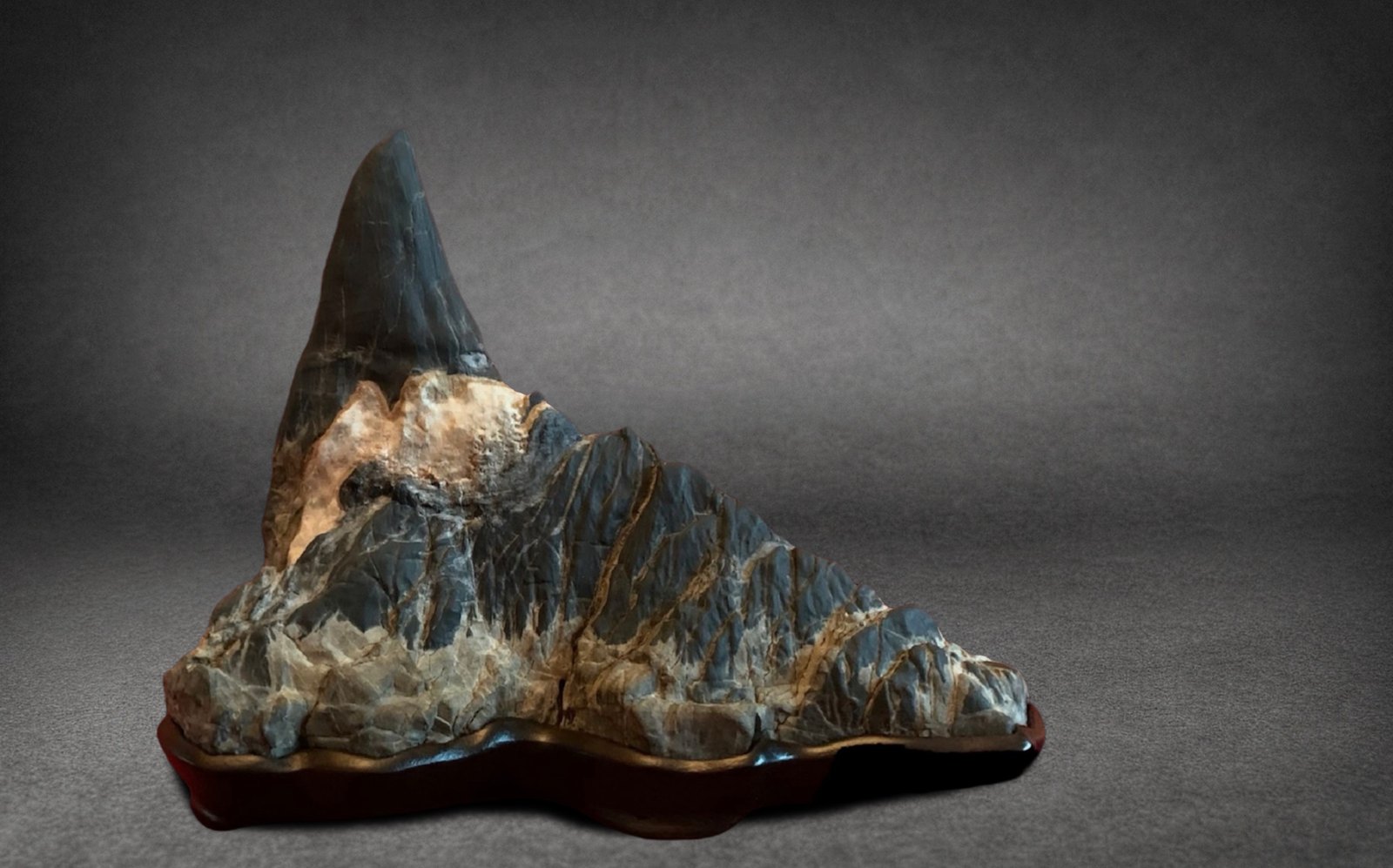
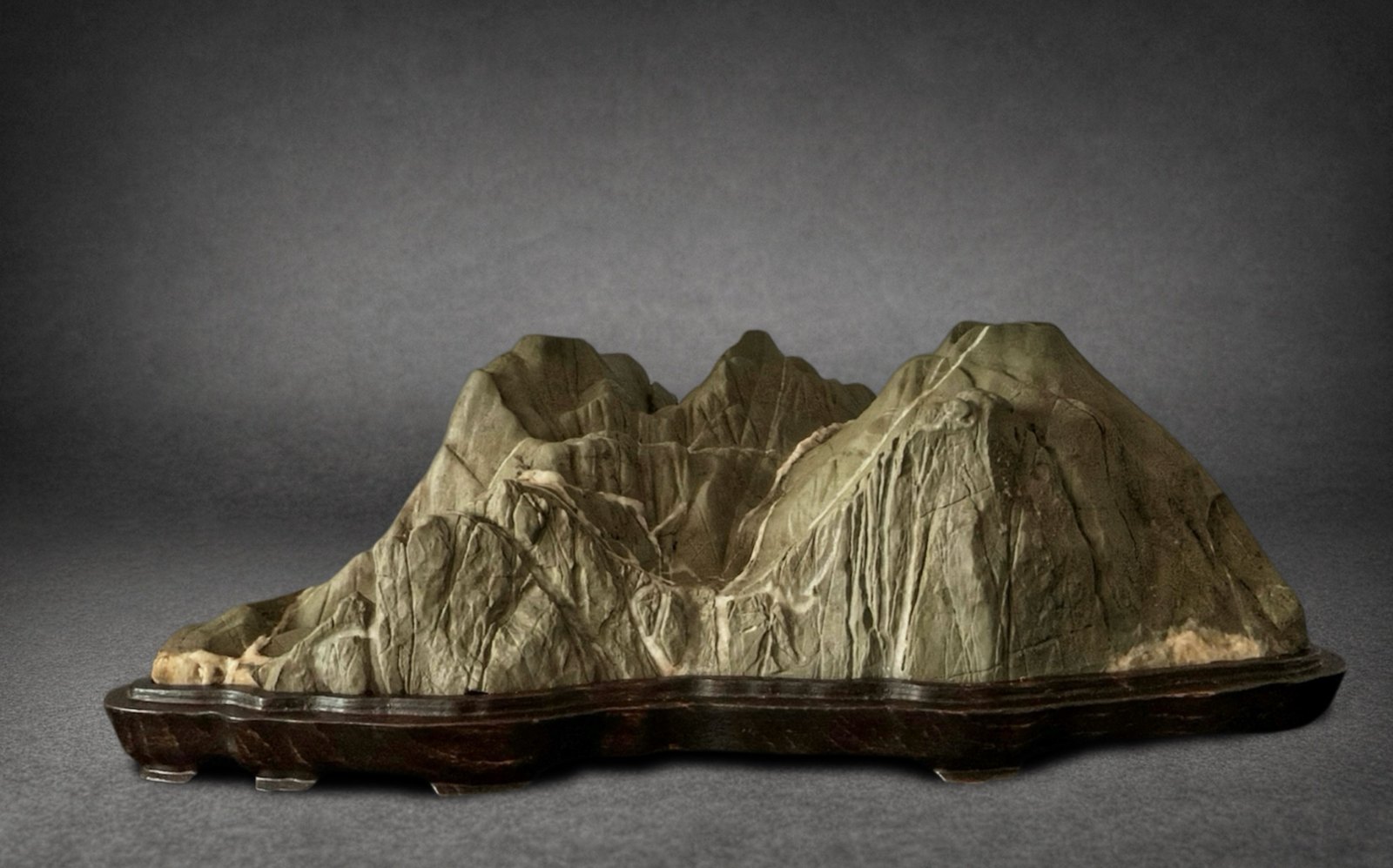
Photograph 1. Focal Point and Asymmetry The stone’s defining feature is a quartzite inclusion that evokes a frozen waterfall or a persistent snowfield in a shaded valley, descending into a small hollow. It forms the focal point, deliberately offset to the right, and the difference in height between the two sides reinforces the asymmetrical balance.
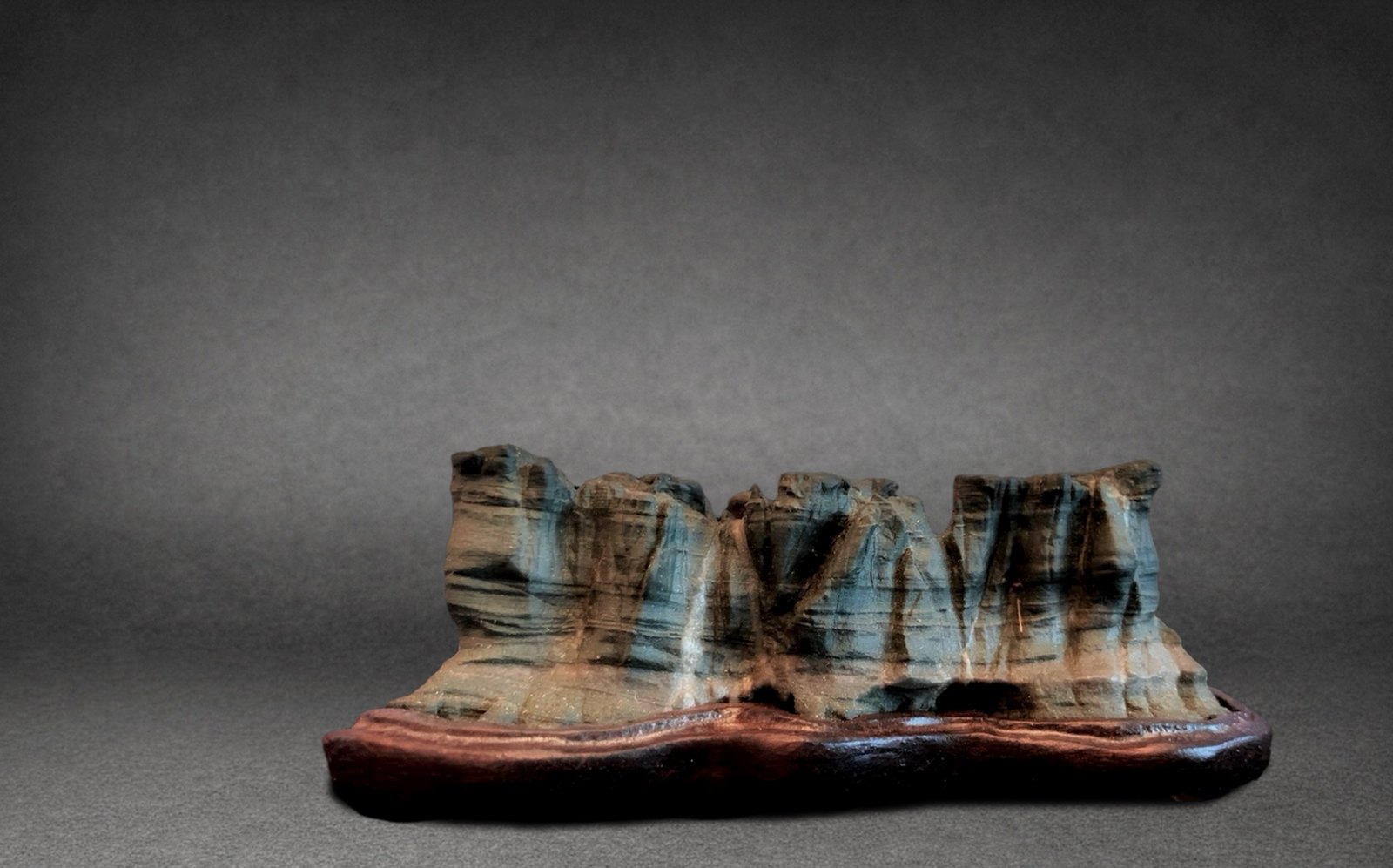
Photograph 2. Focal Point, Asymmetry, and Depth The highest peak, slightly off center and set farther back, acts as the focal point and avoids a static arrangement. Although the depth is not especially pronounced, the differentiation between planes provides sufficient three-dimensionality. A clear example of how subtle shifts in position can significantly enrich a composition.
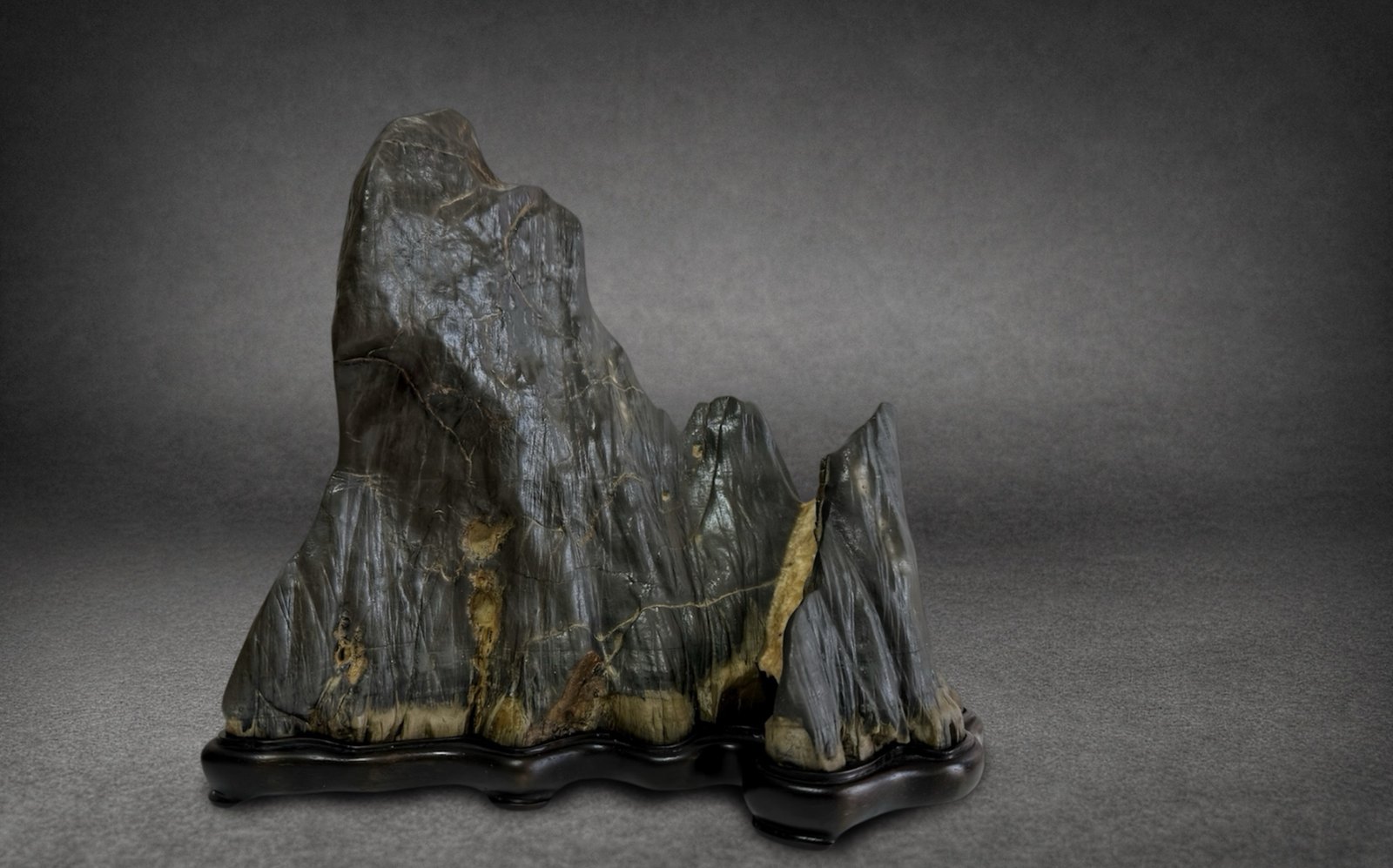
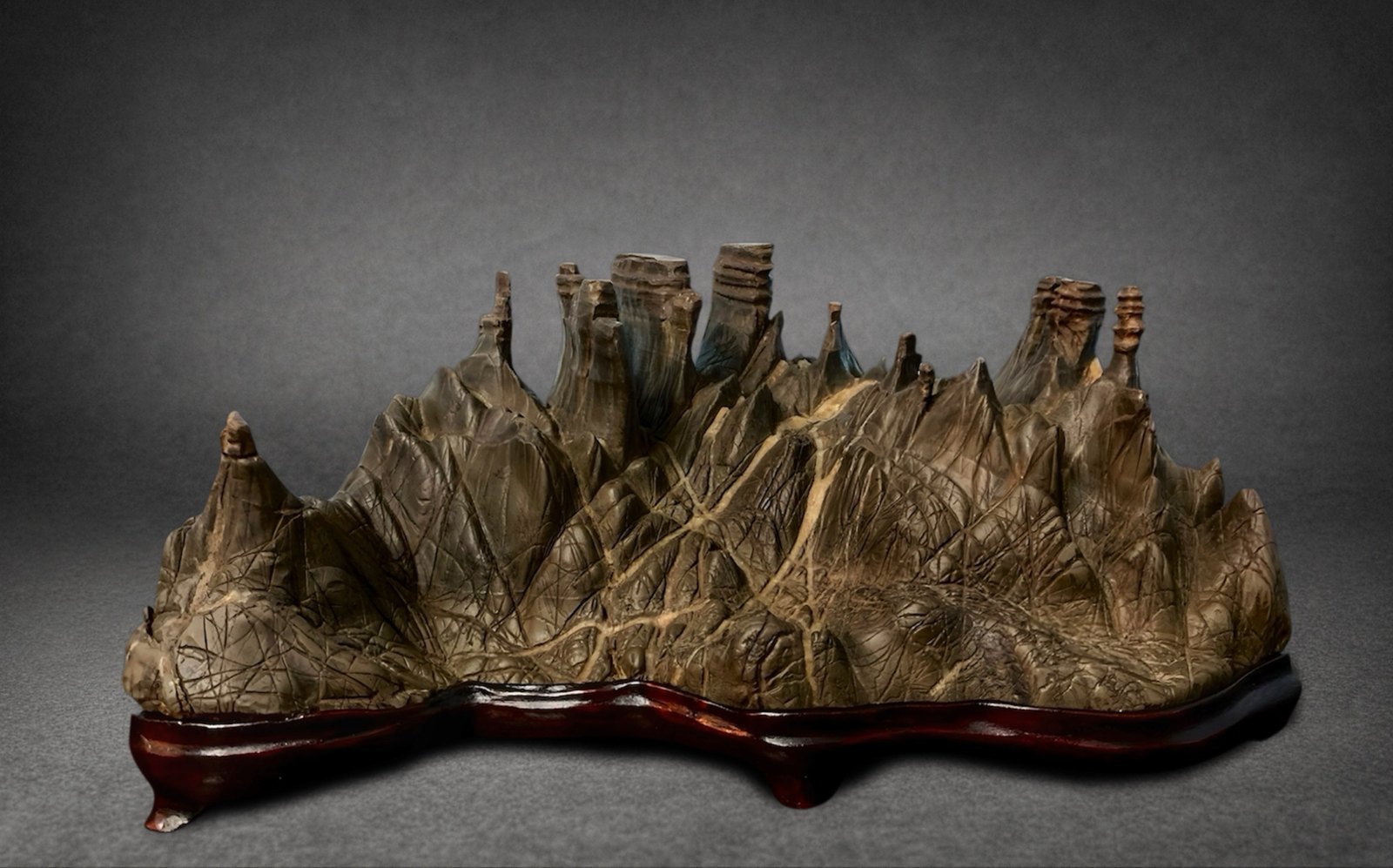
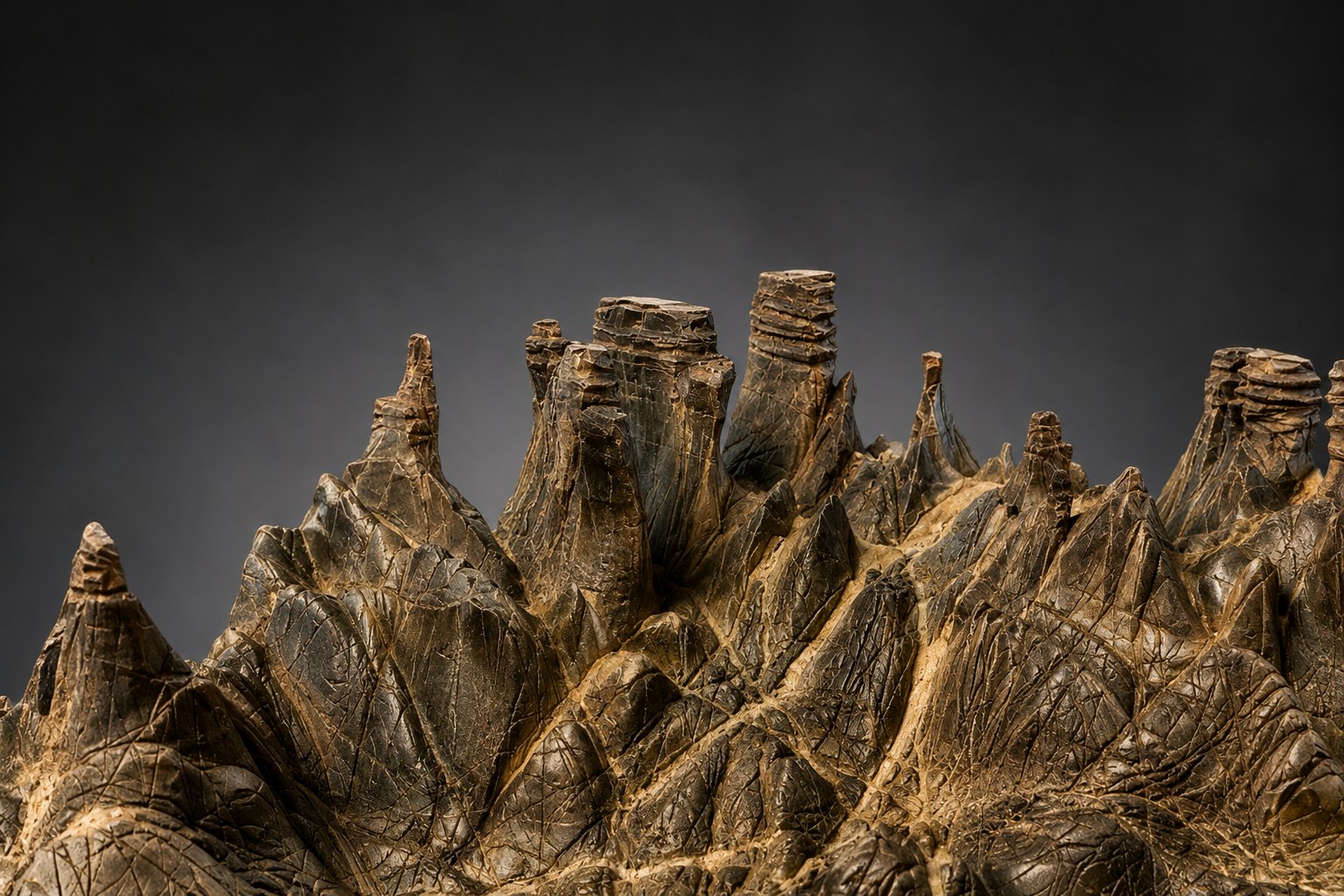
Photograph 3. Focal Point, Rhythm, and Visual Exit The eye converges on a semicircular depression resembling a small natural amphitheater, where the descending formations appear to meet; this hollow is the stone’s main focal point. Three asymmetrically arranged elevations combine older, weathered peaks with a sharper, apparently younger peak set farther back, which enhances the sense of depth. Their related but varied forms create natural rhythm, and the left-hand slope provides a visual exit.
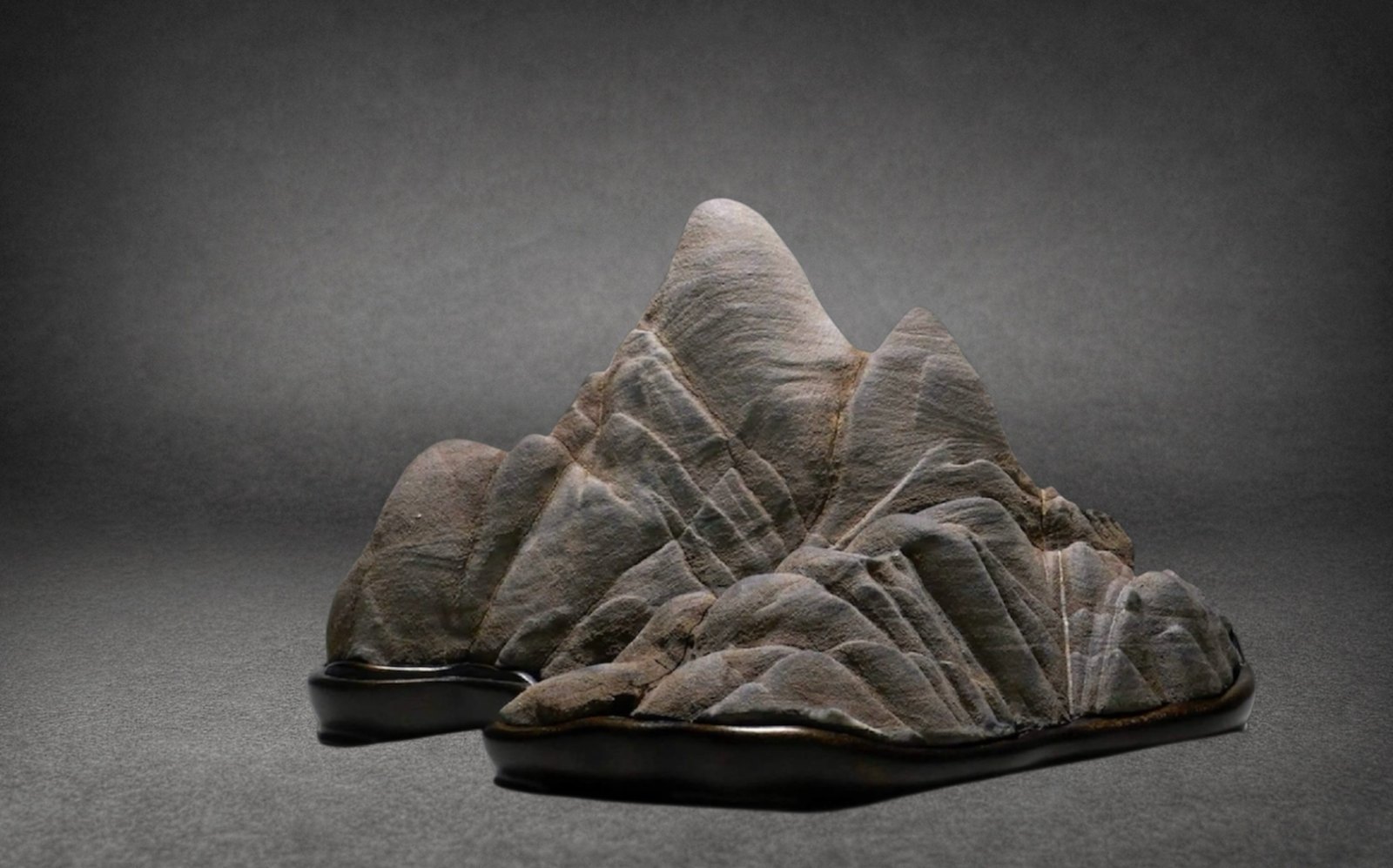
Photograph 4. Focal Point, Asymmetry, and Texture A waterfall stone whose main point of interest is displaced from the center of the composition. The position of the cascade breaks symmetry and gives the scene a more natural character. The rough surface and wealth of detail agree with the proximity from which a waterfall is usually observed in nature: texture reveals the irregularities of the terrain and reinforces the impression of a nearby landscape.
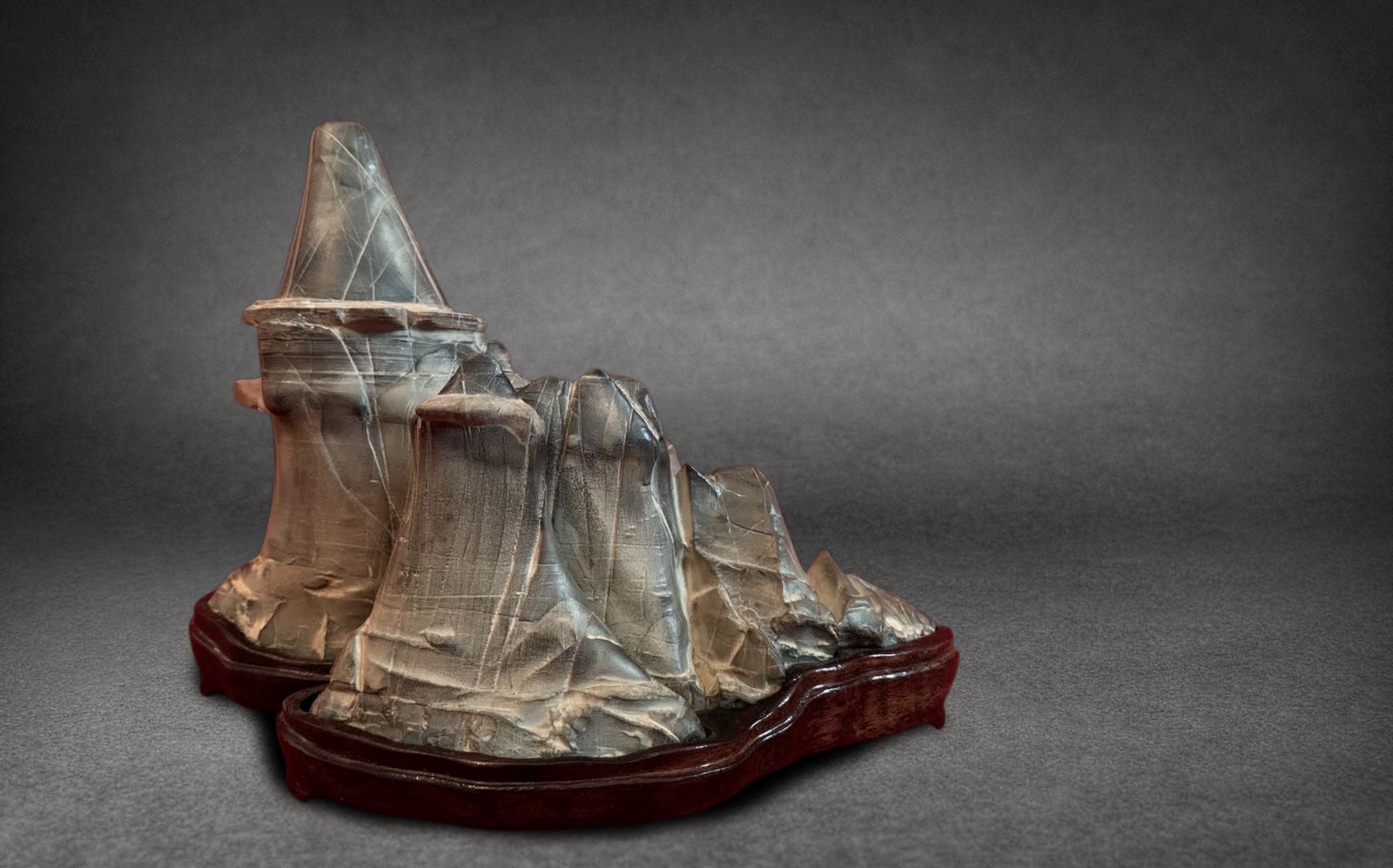
Photograph 5. Asymmetry, Focal Point, and Contrasting Erosion The most striking feature of this stone is its pronounced asymmetry. The waterfall sits well to the right, and the lower peaks on that side appear younger, while the highest relief on the left is far more heavily eroded. The waterfall may equally be read as a frozen cascade or a snowfield lying in a deep depression, where the sun scarcely reaches and snow and ice linger longest. It ends at the base in a kind of cave, which adds a further point of interest.

2. Depth

A stone is a three-dimensional object, but we view it from a single vantage point. Depth is the sensation that there are successive planes: nearer parts, intermediate parts, and parts that recede toward the background. When the different reliefs step back through space, the stone stops looking like a flat sheet and acquires volume, presence, and mystery.

Depth is, on its own, a highly aesthetic quality, and the reason is a fundamental one. A suiseki, and landscape stones (sansui keijō-seki) in particular, seeks to recreate a landscape: a distant mountain, an island, a waterfall, a coast. Natural landscapes are three-dimensional: they extend in planes that follow one another from the near to the horizon. If we want a stone to convey the image of a landscape, it is logical that it possess that same dimension. When it does, the scene becomes more believable, we connect with it more intensely, and our senses readily accept that we are looking at a real setting, reduced in scale. Depth gives the stone the space it needs to evoke a landscape.

From the viewing position, it is worth asking whether I can make out layers: a projecting ridge, a flank that recedes, a hollow that leads the eye inward. A “flat” stone, however interesting its silhouette, often lacks force because it offers no path to follow.
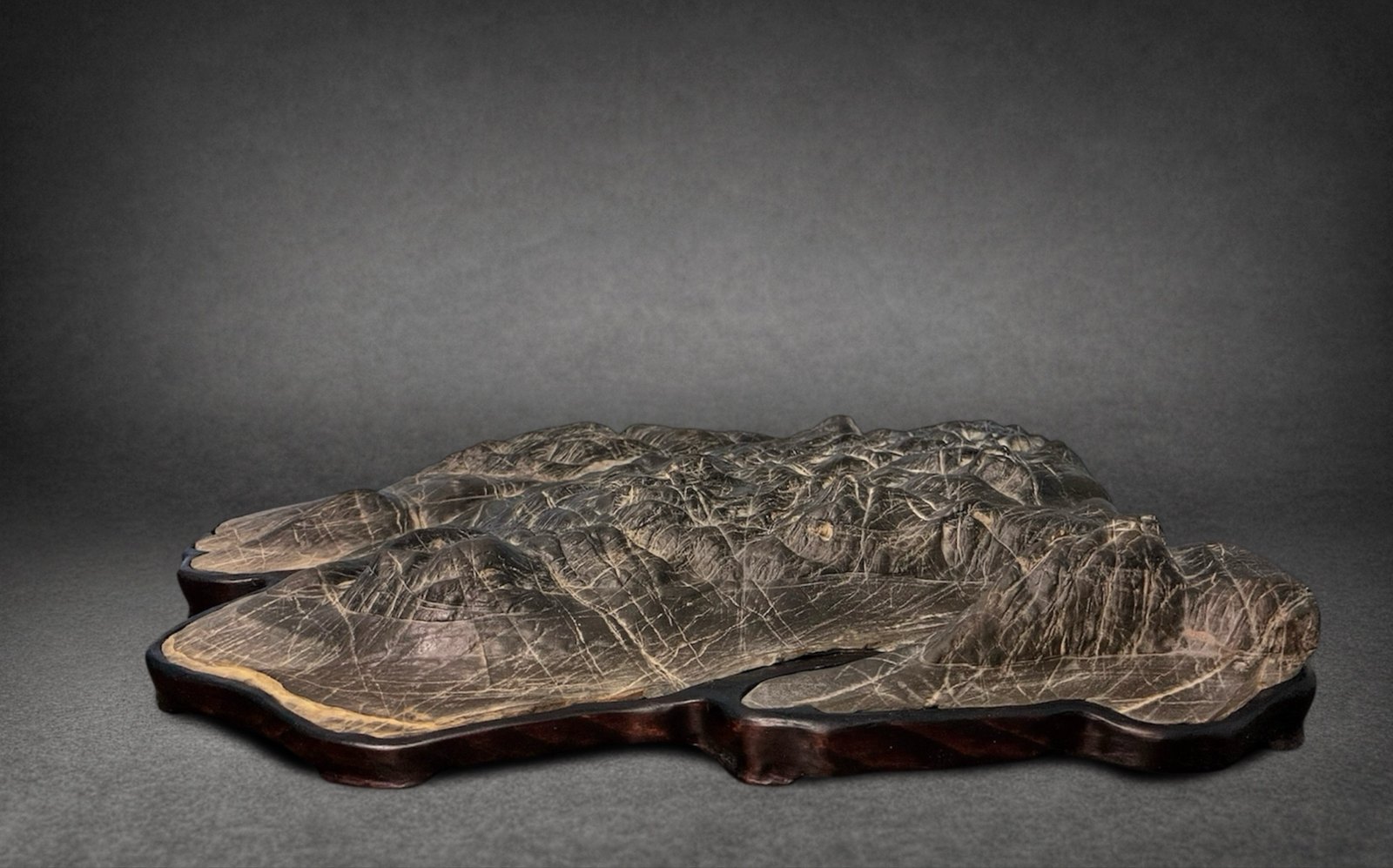
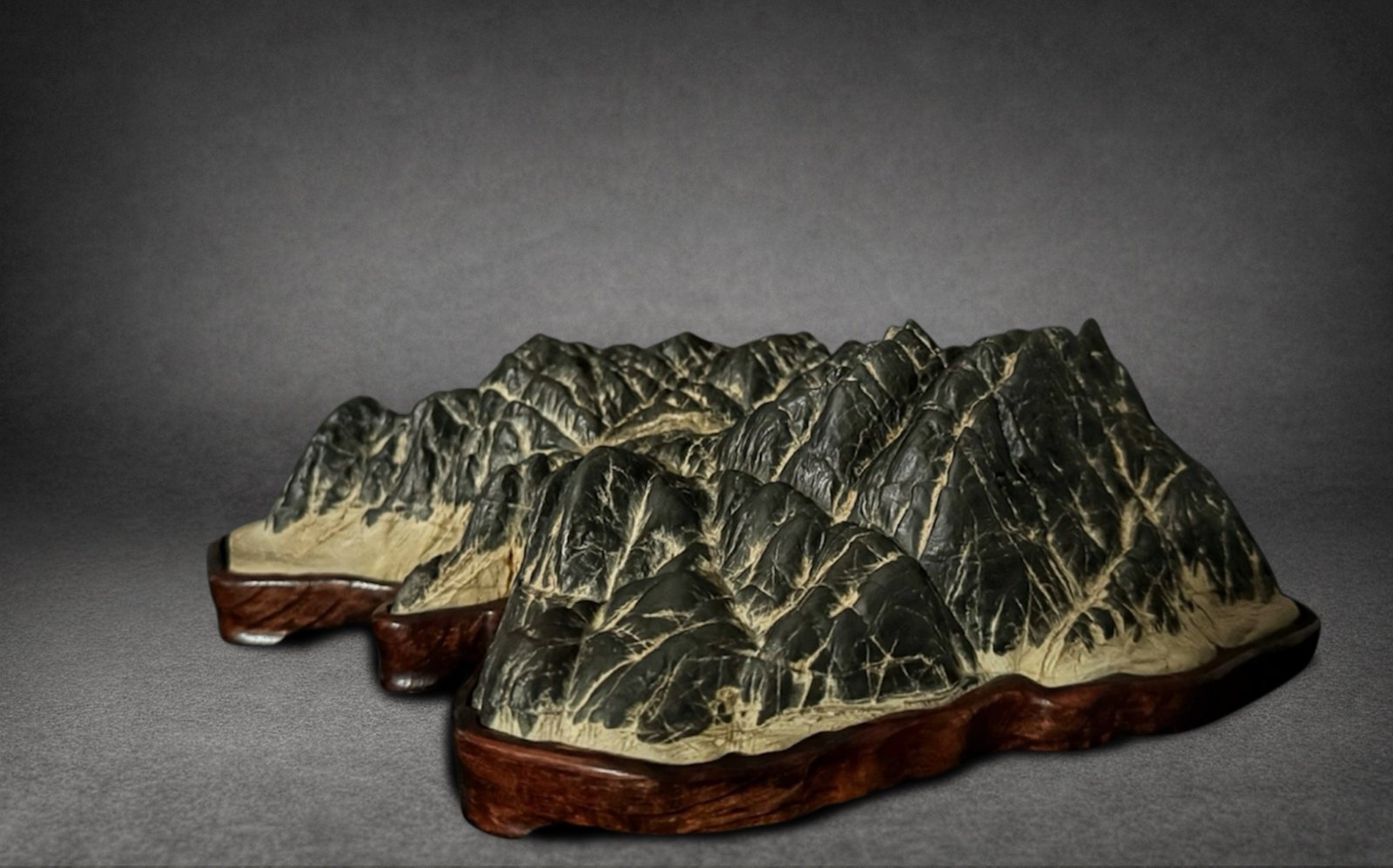
Photograph 6. Depth and Perspective A distant-landscape stone evoking an extensive plateau shaped by prolonged erosion. Its pronounced three-dimensionality emerges through successive planes receding into the distance, creating a strong sense of depth and perspective.
Photograph 7. Depth, Rhythm, Movement, and Unity A stone of remarkable aesthetic richness, in which depth and unity work together. Its numerous related but never identical formations rise and fall in a stepped progression, like waves or a cascade of forms. Repetition with variation creates rhythm, while continuity between the planes conveys strong movement without compromising coherence.
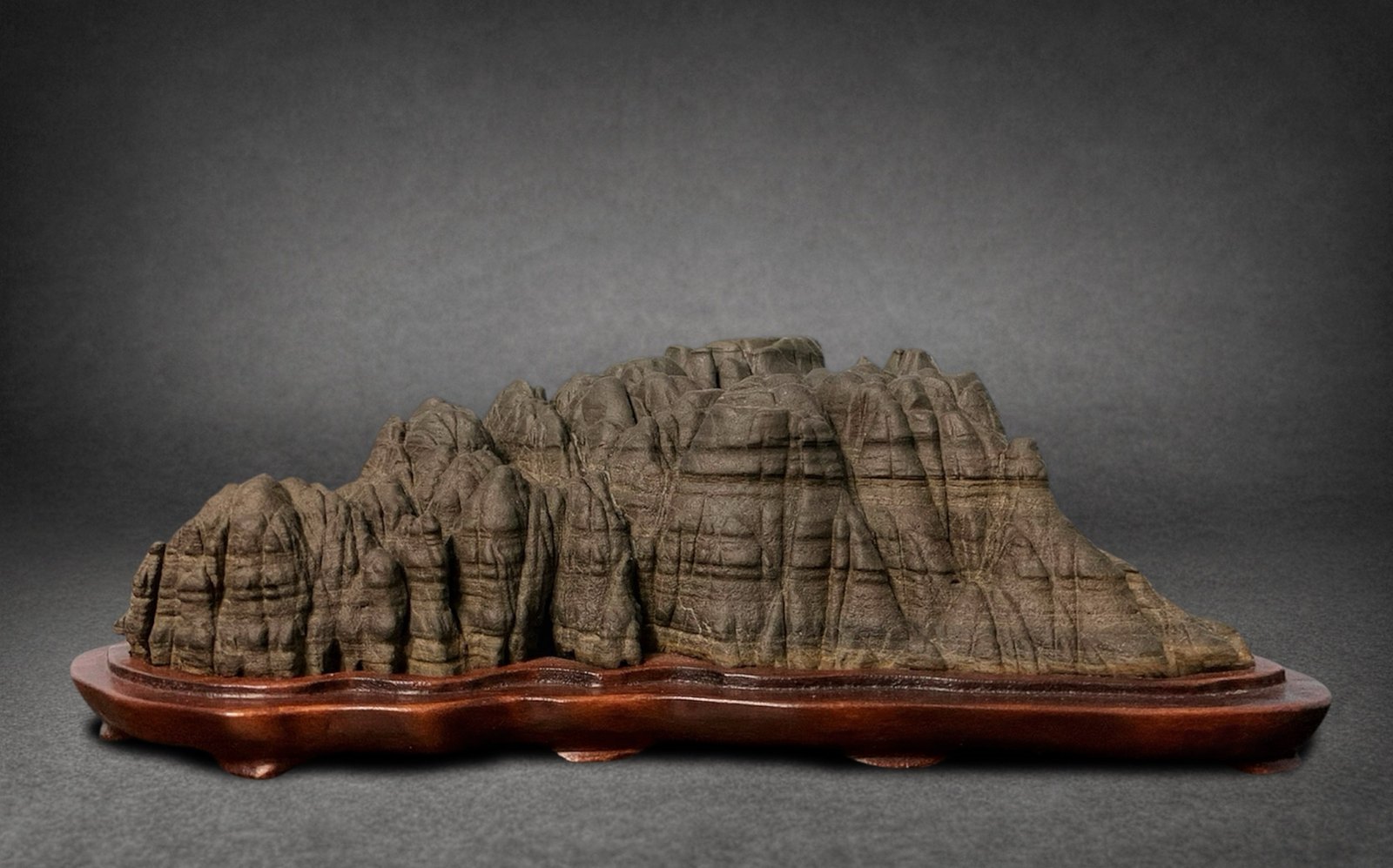
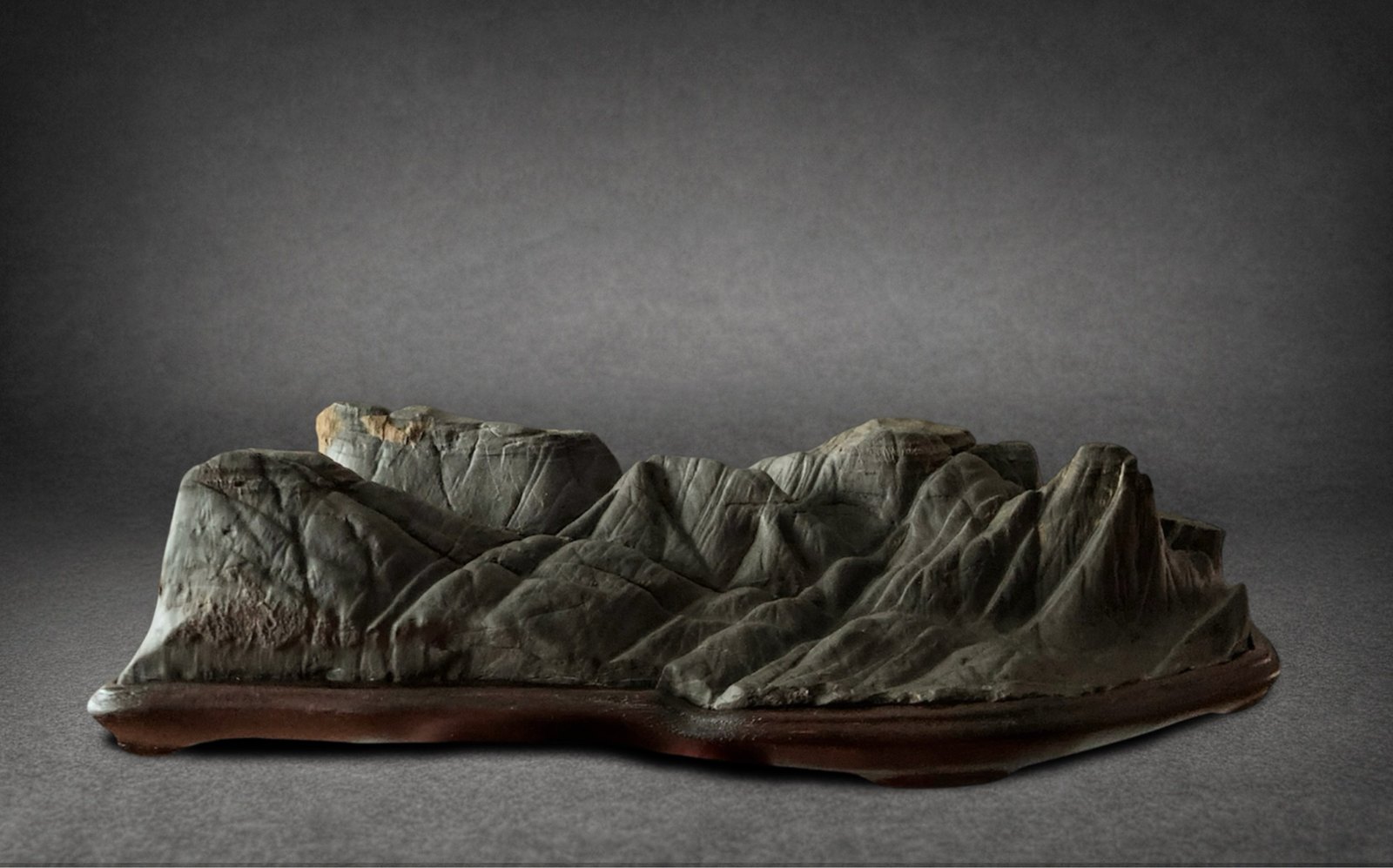
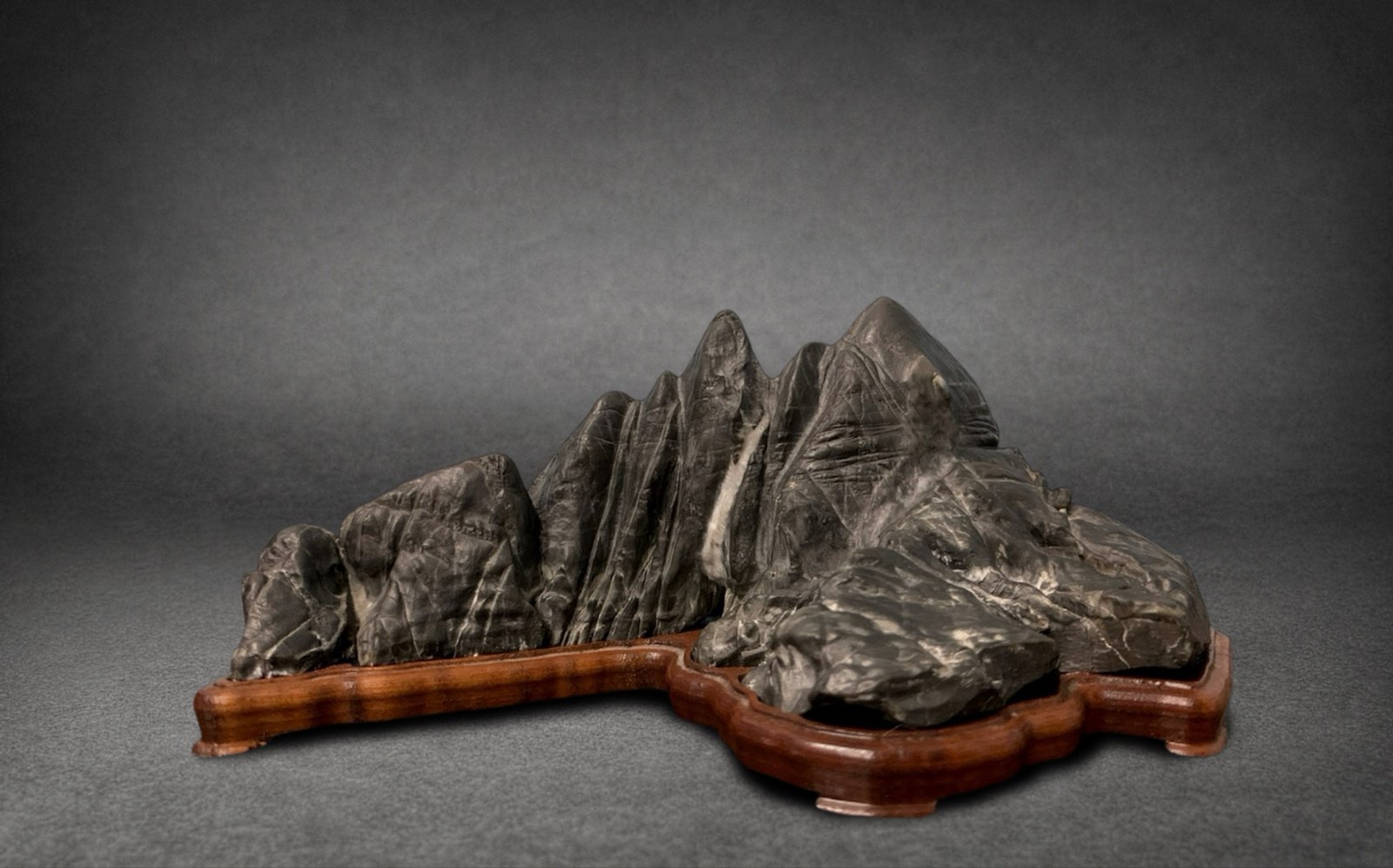
Photograph 8. Depth, Breaks, and Rhythm A stone of considerable aesthetic quality, notable above all for its depth and rhythm. Although a frontal photograph cannot fully convey its three-dimensional structure, the daiza’s pronounced U-shaped extension toward the rear suggests the piece’s depth. Its many formations vary in height, shape, and direction, creating a succession of breaks that enriches the visual progression. The grayish tone and pronounced texture of the sandstone agree with a landscape seen from an intermediate distance.
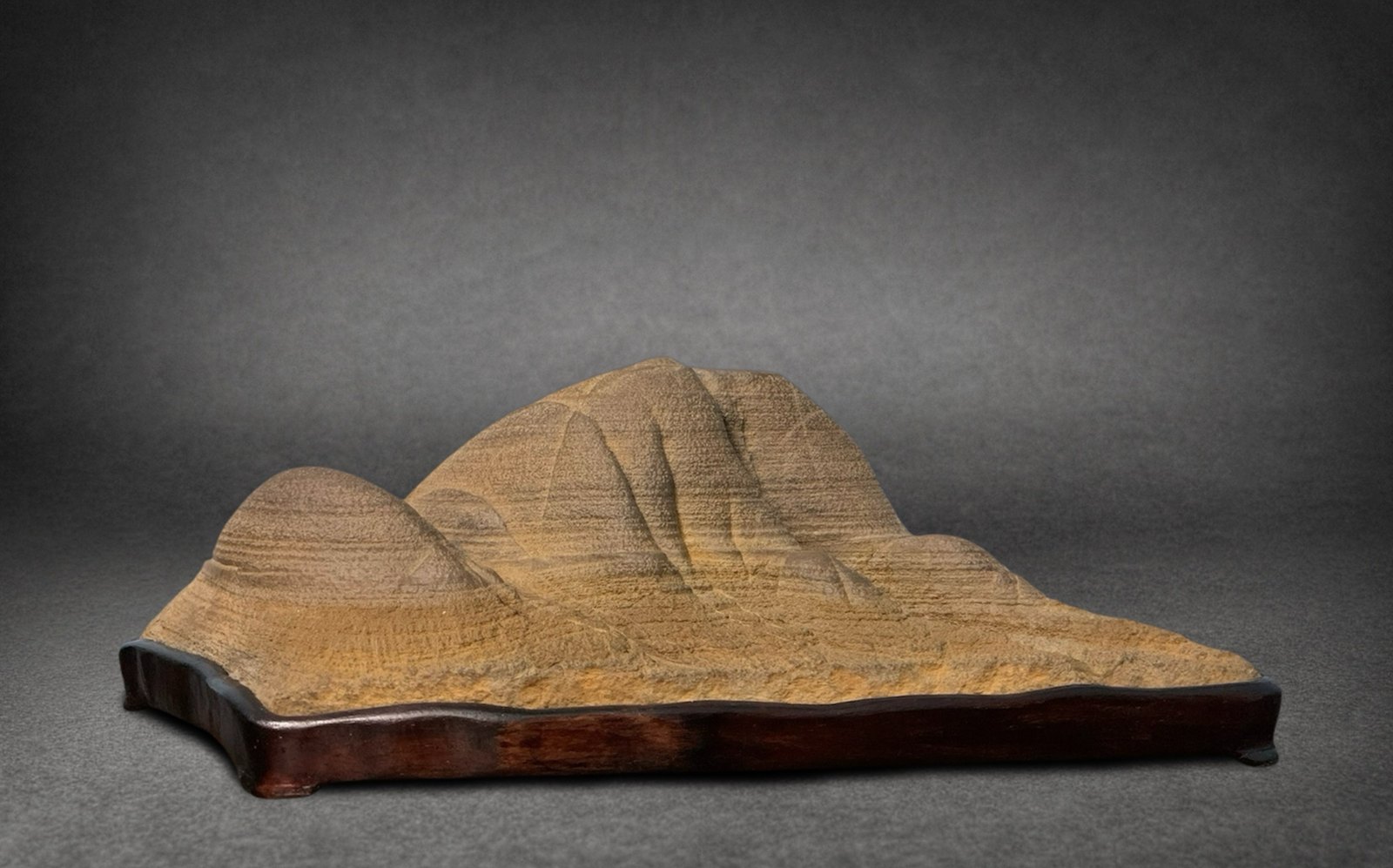
Photograph 9. Depth and Perspective An extensive plain or plateau seen from a distance, its depth suggested by a succession of barely perceptible planes. The exceptionally smooth surface has only gentle undulations and virtually no prominent elevations. This absence of pronounced detail is not a limitation but an essential feature of the distant landscape it evokes: as distance increases, minor variations in the terrain lose definition and merge into a more continuous visual surface.
Photograph 10. Unity, Rhythm, and Asymmetry A stone of exceptional aesthetic quality, in which unity and rhythm are especially prominent. Its elevations share a distinctive erosional feature: horizontal grooves and lines across their upper surfaces, recurring throughout the composition. Each peak, however, shows subtle differences in the height, width, and depth of these marks; some are more pronounced, others softened or partly worn away. This repetition with variation avoids monotony and creates a strong visual relationship between the formations, and their asymmetrical arrangement completes a composition of considerable formal richness and coherence.
Photograph 11. Depth, Rhythm, Unity, and Movement A stone combining numerous aesthetic qualities. Although a frontal photograph cannot fully convey its three-dimensionality, several distinct planes are visible: foreground formations, intermediate levels, and elevations receding into the background. This depth is combined with considerable variety of shape and height; the elements resemble one another without being repetitive. The eye rises gradually from the left, reaches its highest point about two-thirds of the way across, and then descends more decisively to the right. The relationship between the formations creates both unity and movement.

3. Asymmetry

Symmetrical forms convey stability and order, but when the symmetry is pronounced they become static and predictable: the eye has no reason to turn to one side rather than the other. What draws attention and is remembered tends to avoid strict symmetry. Painters rarely depict a person or an animal rigorously head-on, because the result would be stiff and lifeless.

It is true that nature is not governed by symmetry, but it sometimes produces coincidences: two peaks of almost identical height, two mirror-image slopes, a perfectly centered cavity. When such coincidences produce an overly obvious symmetry, they take away interest from the piece and make it more predictable. A stone with forms that differ from one another, with uneven heights and different masses on each side, is generally more interesting.

There is also a contextual reason. The stone is displayed on a daiza or a suiban, usually symmetrical, in a display space that is likewise orderly. Against that regular frame, the stone’s asymmetry creates a contrast that sets it off. A symmetrical form within a symmetrical frame can dissolve into a sea of repetition.
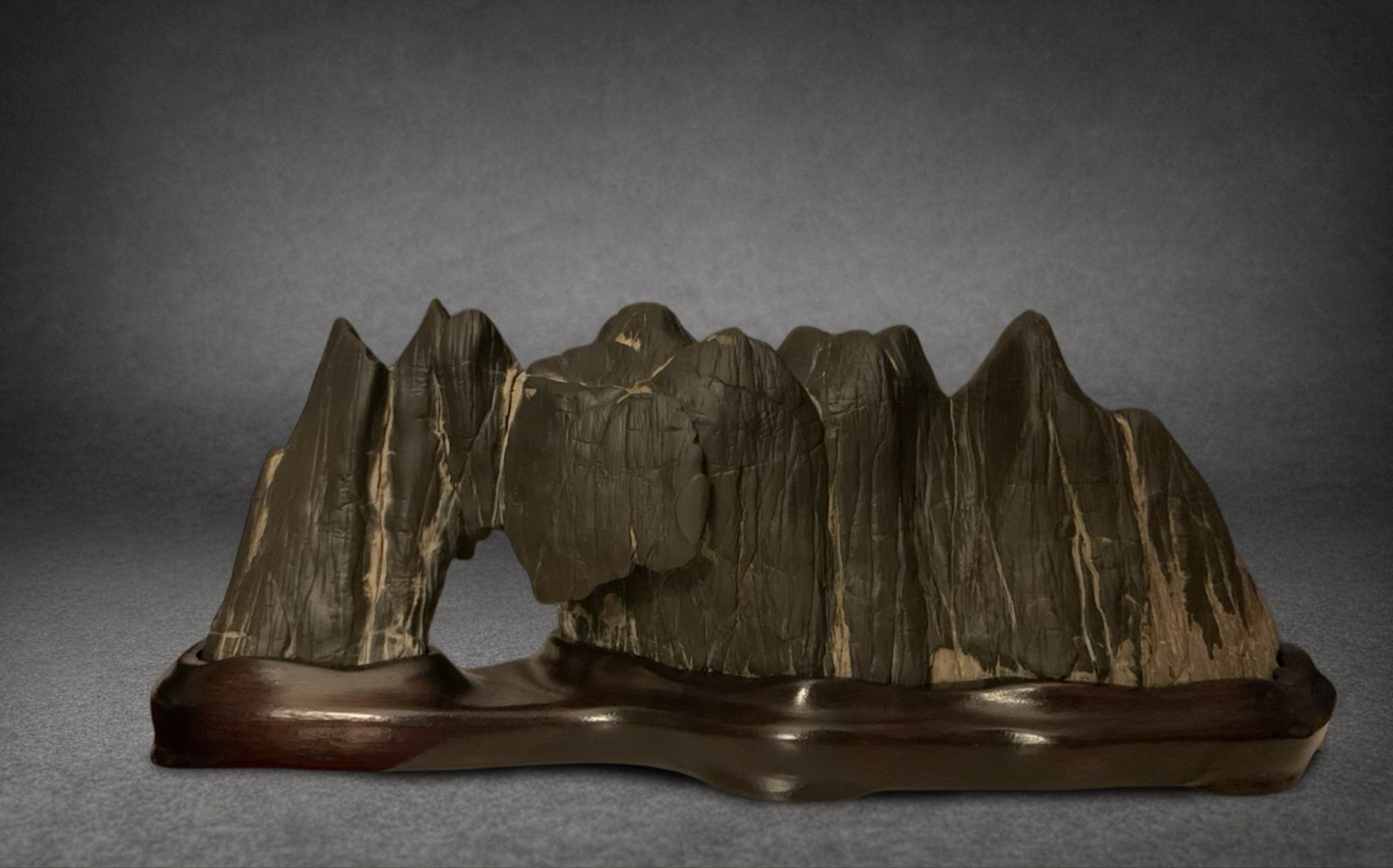
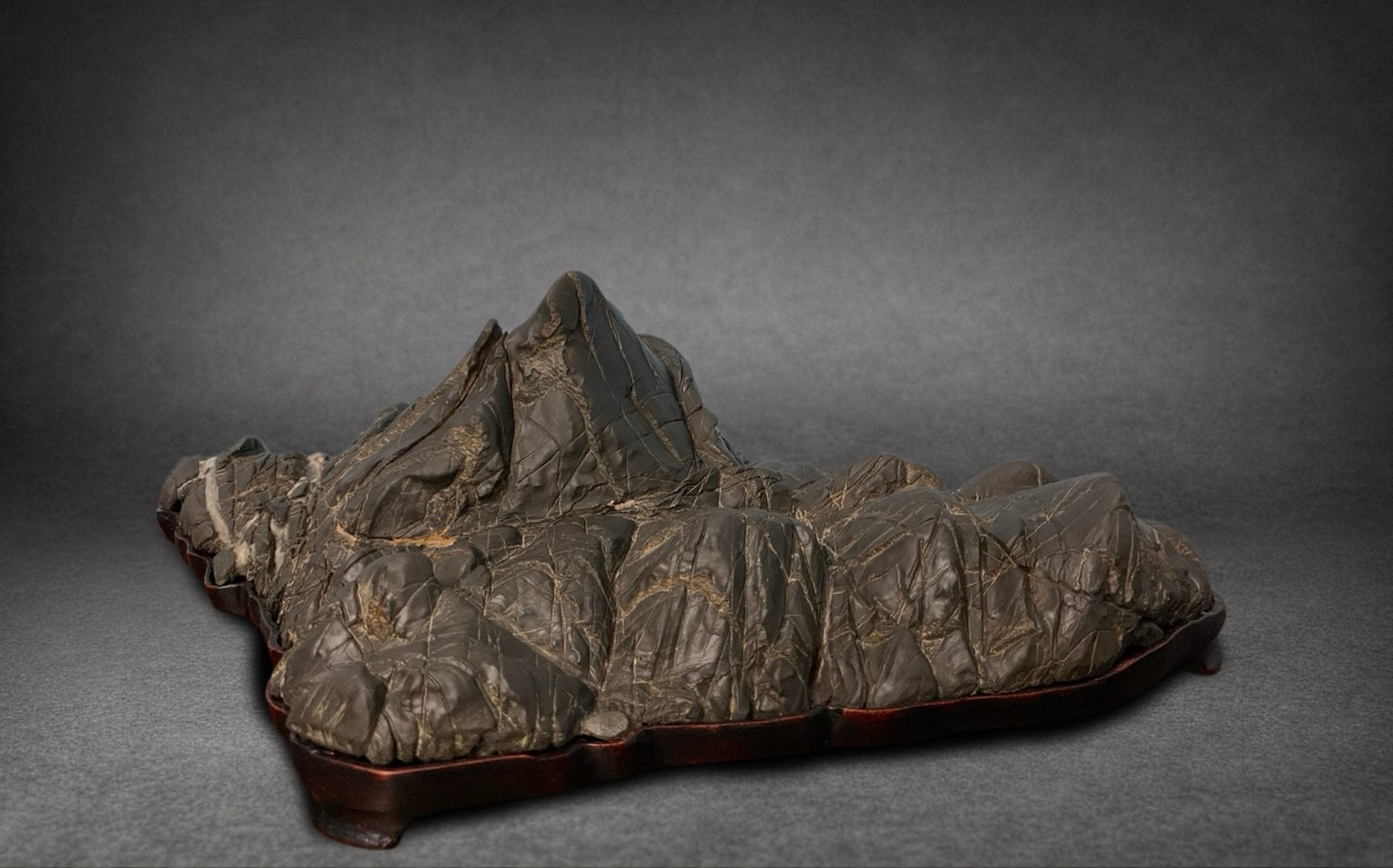
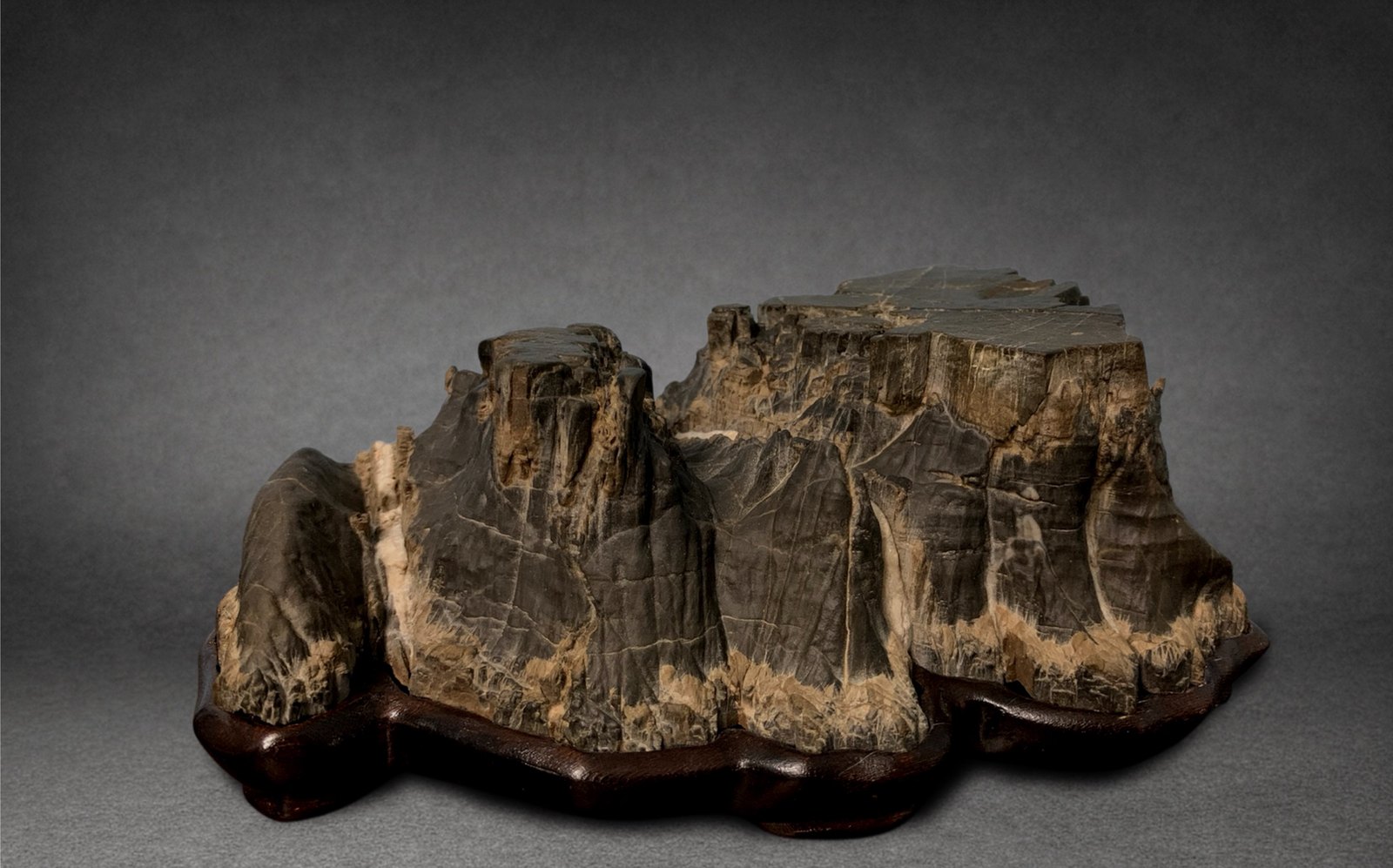
Photograph 12. Asymmetry, Negative Space, and Texture Two distinct features contrast here: a mountainous formation on one side and a hollow resembling a natural arch or tunnel on the other. This pronounced asymmetry enriches the stone’s character. The abundant detail and rough texture reinforce a sense of proximity, suggesting a landscape best appreciated at close range.
Photograph 13. Asymmetry and Balance A particularly clear example of compositional asymmetry. The dominant peak is displaced to the left and set slightly behind the frontal plane, avoiding a centered, predictable arrangement. Although the depth is modest, subtle changes in level and position provide the necessary three-dimensionality. A few carefully proportioned differences are enough to produce a composition of great beauty.
Photograph 14. Asymmetry, Focal Point, and Unity An asymmetrical composition dominated by two peaks of markedly different heights. Beneath both summits, formations suggest clouds and create a visual link despite the difference in scale. The dominant peak, positioned off center, attracts the eye, while the second echoes and complements its character. Their resemblance creates unity without relying on symmetry.
Photograph 15. Asymmetry, Rhythm, and Visual Exit A distant mountain range formed by three asymmetrically arranged elevations of different heights. The main peak sits slightly left of center, while the other two occupy different positions on the right. Small valleys and depressions connect the formations, and the overall slope descends gradually to the right, guiding the eye to a natural visual exit. The unequal arrangement avoids monotony and gives the composition a sense of movement.

4. Rhythm

Rhythm is the succession of elements that repeat with variation: reliefs at different heights, intervals that shorten or lengthen, peaks of different sizes that follow one another. A lively rhythm is not a mechanical pattern. If the reliefs repeat too regularly, the sensation is monotonous; if they vary in an orderly way, the eye travels over them with pleasure, as one follows a melody.

It should be stressed that rhythm demands variation, but within an order. It is not a matter of varying for the sake of varying. A stone with highly diverse reliefs and no relationship among them has no rhythm, only disorder, and the chaotic is not aesthetic either: the eye finds no path to follow and ends up tiring. Rhythm arises when diversity obeys a certain logic, for example when intervals grow or shrink gradually, when heights follow one another in a recognizable progression, or when forms answer one another. Between the monotony of the repeated and the chaos of the arbitrary lies rhythm.

A good test is to follow the upper profile of the stone with the eye and check whether one perceives intervals that are unequal but related to one another, rather than a uniform succession.
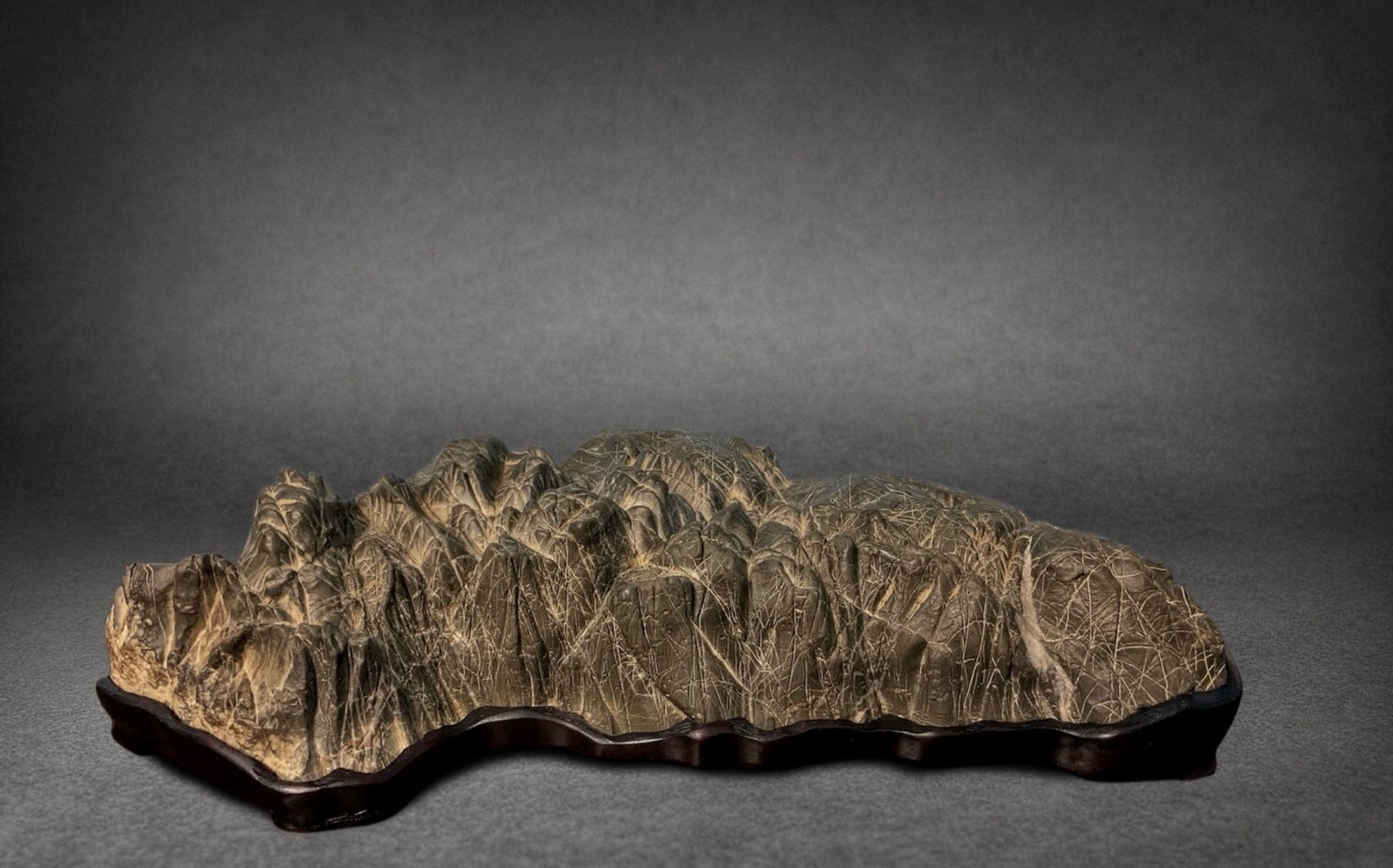
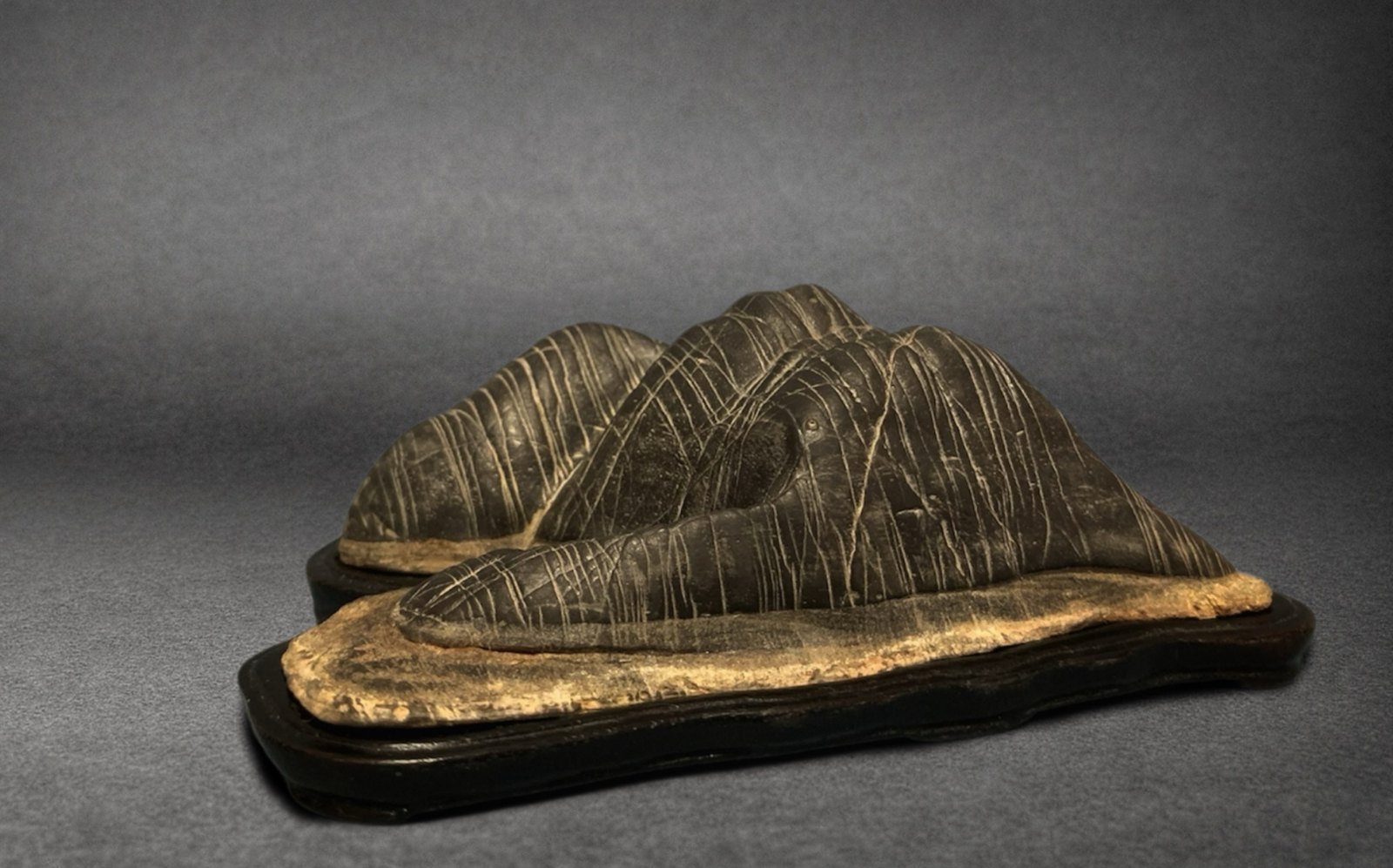
Photograph 16. Unity and Rhythm At first glance the stone may seem somewhat monotonous because of its relatively regular outline. Closer observation reveals a remarkable variety of formations, small elevations and depressions, each with its own character. Their repeated forms, subtly varied in height and configuration, create a continuous rhythm, and this diversity, organized within a coherent formal structure, gives the composition its unity and visual richness.
Photograph 17. Depth, Unity, and Visual Exit A small stone distinguished by its remarkable three-dimensionality. Its depth is especially apparent from above, where a pronounced U-shaped configuration, echoed by the curvature of the daiza, becomes visible. The formations share a consistent visual character, with subtle variations in height and shape that create rhythm and unity. The foreground relief descends almost to the level of the base, providing a natural visual exit.

5. Breaks and Changes of Direction

A completely continuous line lulls the eye. When a profile or relief changes direction, breaks, is interrupted, or resumes at another angle, the eye stops, wonders what is happening, and wants to keep discovering. Breaks give character and vigor to a line, just as a brushstroke gains expressiveness from one or two well-placed bends.

Since stones come from nature, they can be expected not to be excessively regular. Even so, some stones have more breaks and changes of direction than others. When those changes are well integrated into the overall form, they enrich the composition and make it more attractive, because each part we observe is slightly different from the last and awakens the desire to understand it: to see what that form is like and how it fits with the others. It is not the quantity of breaks that gives beauty, but their integration.
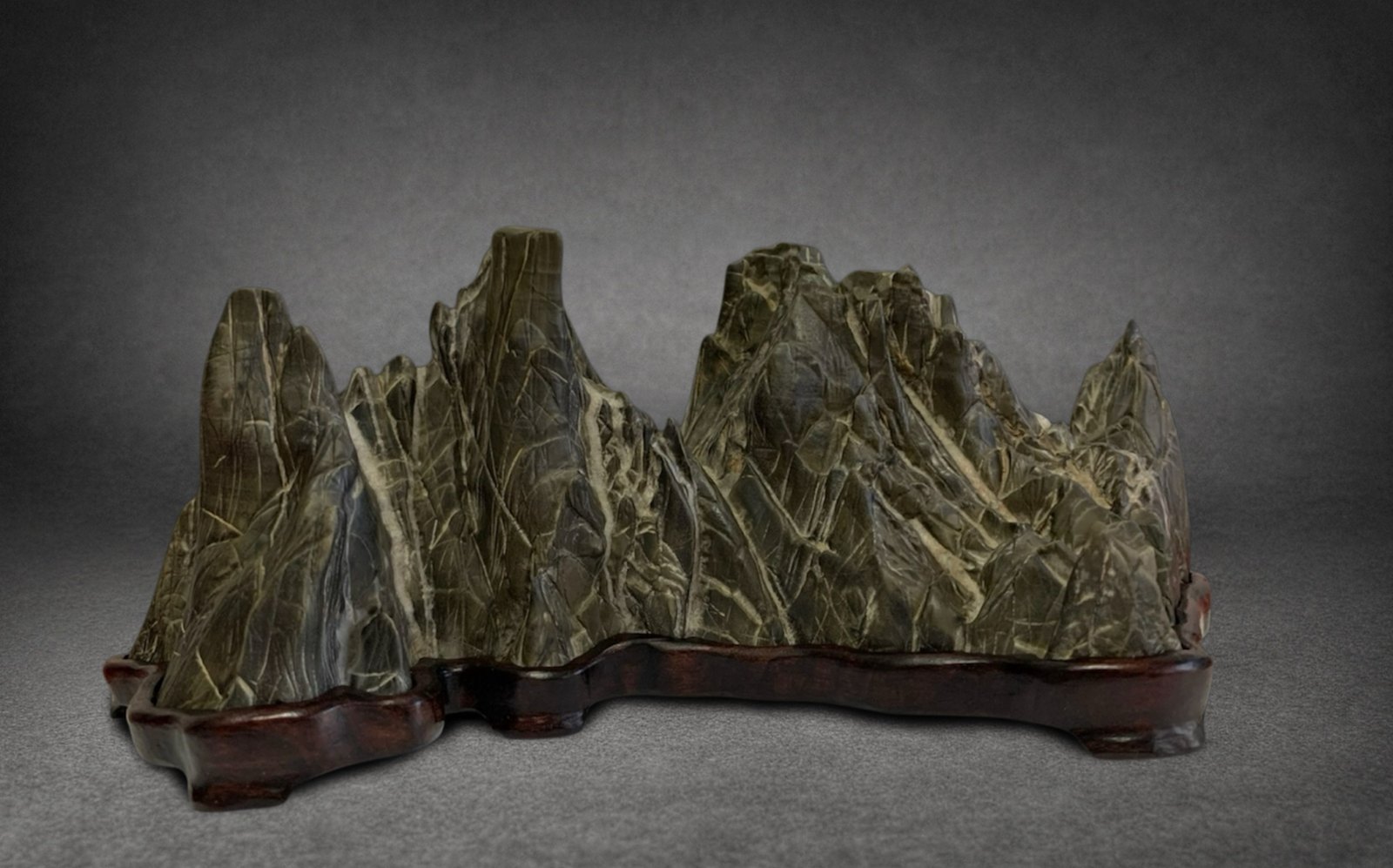
Photograph 18. Breaks and Rhythm A succession of breaks and changes of direction that maintain a coherent relationship rather than creating disorder. The planes vary in depth, and the peaks, similar in character but subtly different in height and shape, create visual rhythm and richness.
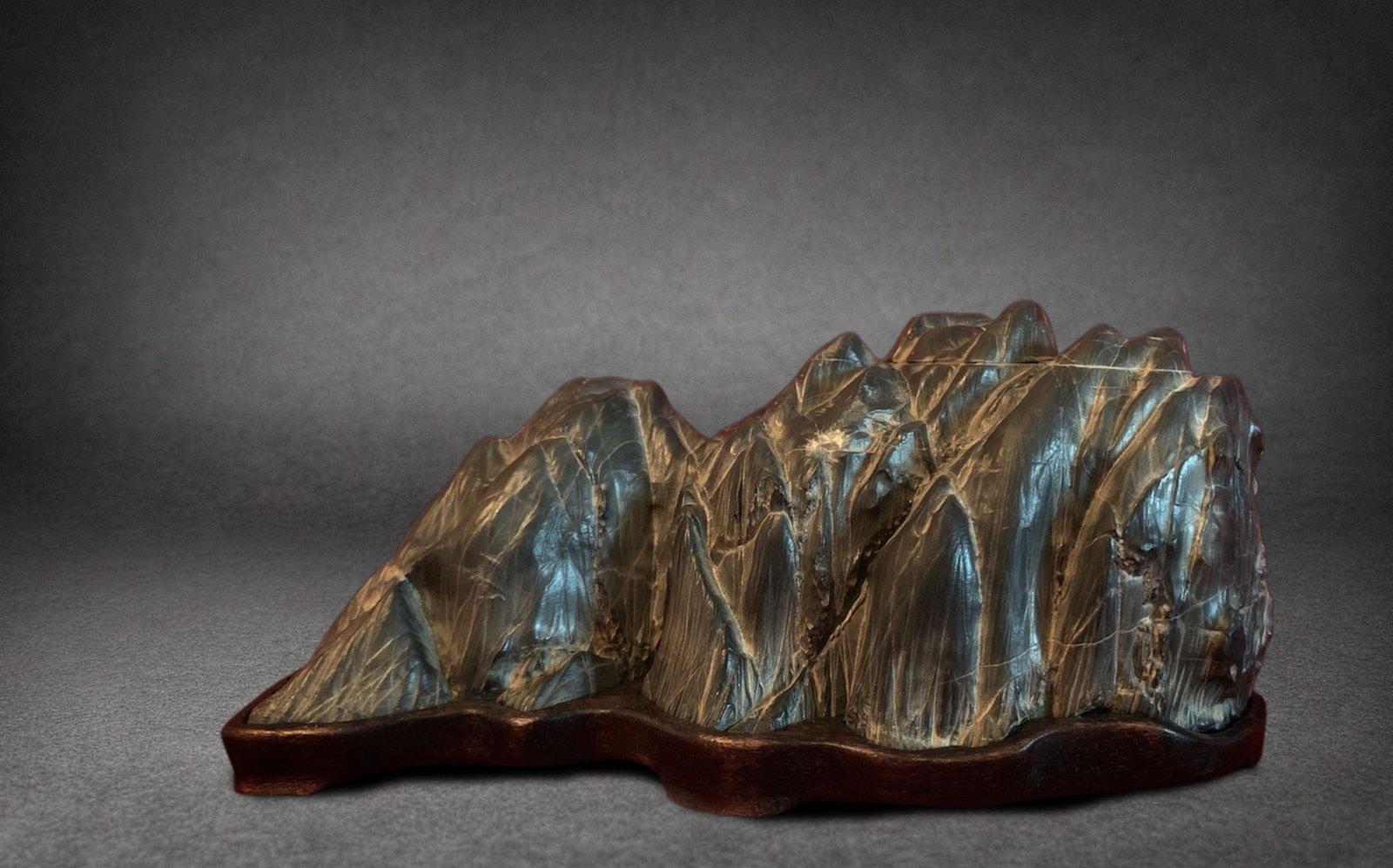
Photograph 19. Breaks and Movement Fractures and changes in the direction of the formations suggest geological movements that displaced and deformed the rock masses. The elevations lean at different angles instead of rising vertically, introducing tension and movement into a composition that nevertheless retains its overall unity.
Photograph 20. Breaks, Rhythm, and Unity Two principal breaks divide the stone visually into three groups of formations without compromising its overall unity. The elevations vary in size, height, and irregularity yet share erosional characteristics that suggest a common process of formation. This combination of varied forms and recurring geomorphological features creates a natural rhythm that connects the elements of the composition.

6. Empty Space: Looking at What the Stone Is Not

Every object delimits empty spaces around it and, at times, within itself: the gap left by a cleft, the bay traced by a slope, the arch of a cave. The shape of those voids is as important as that of the stone itself. A very revealing exercise is to view the stone’s silhouette as a black shadow against a light background: what one then sees is the pure outline, and with it the shape of the space surrounding it.

A well-defined void, with asymmetrical proportions and an interesting profile, enriches the piece. An excessively regular, rounded, or symmetrical void tends to impoverish it. And a principal void that is poorly defined, or rivaled by a more striking secondary one, weakens the reading of the whole.
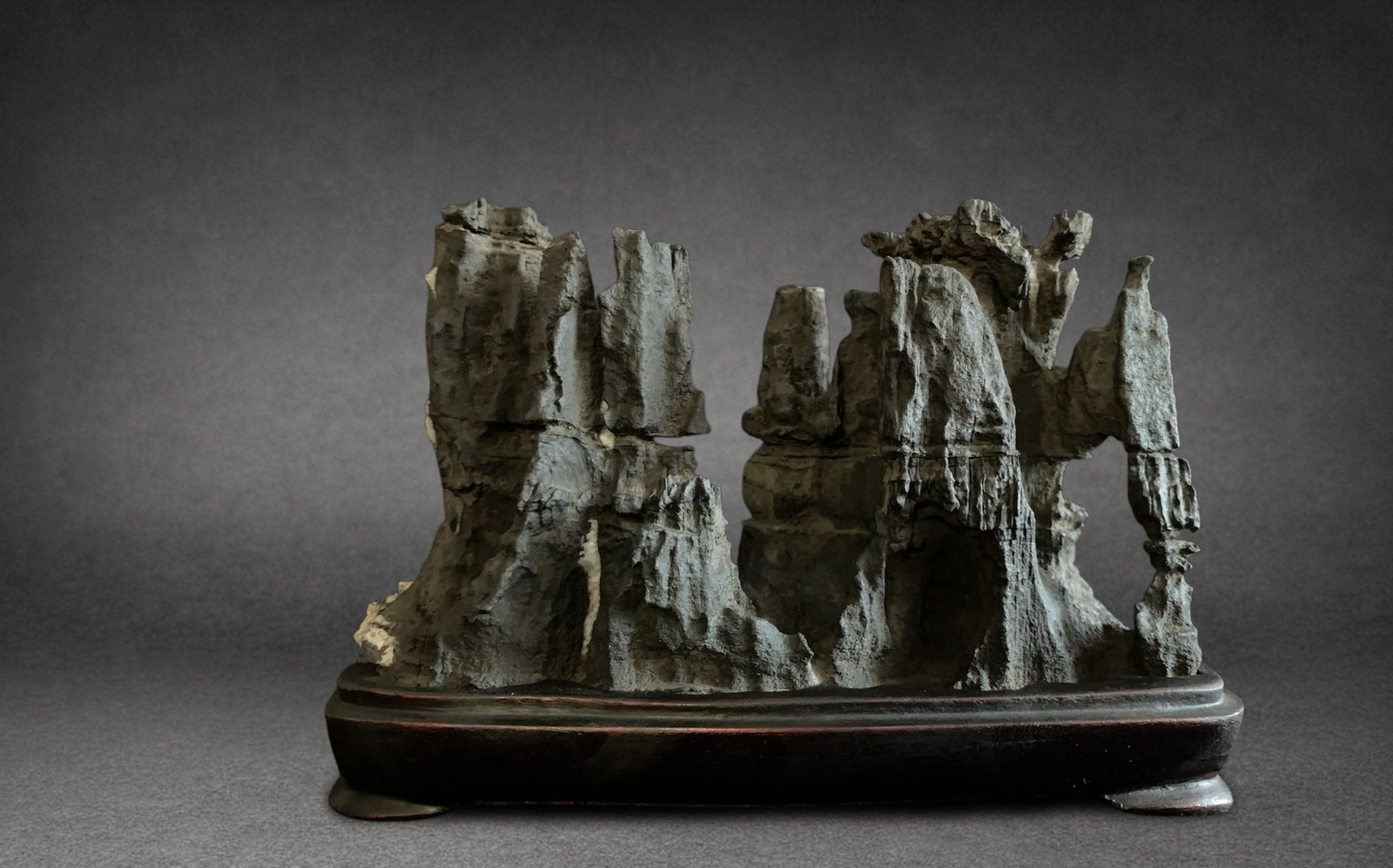
Photograph 21. Negative Space, Asymmetry, Rhythm, and Texture A composition in which negative space plays a central role. Most of the visual mass is concentrated on the right, while a deep break slightly left of center separates two groups of formations that remain connected at the base. Although the heights along the upper profile are relatively similar, irregularities and changes of direction create considerable formal diversity. The abundant hollows and rough texture suit a rocky landscape meant to be viewed relatively close up.

7. Visual Mass and Balance

Objects have a physical weight, but also a visual weight: the sensation of mass they convey according to their size, density, darkness, and position. A zone that is taller, thicker, darker, or more compact tends to weigh more visually than one that is lower, thinner, lighter, or more open.

Balance results from how those weights are distributed. When they are distributed equivalently on both sides of a central axis, the balance is static: stable but motionless. When the weight is distributed unevenly and the whole is nevertheless visually sustained, we speak of asymmetrical balance, generally more interesting.

8. Dynamism: The Sensation of Movement

A stone does not move, but it can give the sense that it is about to. That is, in my judgment, one of the factors that most elevates the aesthetic quality of a suiseki.

The explanation lies in perception itself. The human visual system is especially sensitive to motion: our eyes detect anything that moves and turn toward it almost at once. Works that convey dynamism seem to us more alive and more interesting, and they hold our gaze longer.

How does this translate to a motionless stone? In several ways:

Diagonals. The horizontal line conveys repose; diagonals, moving between the horizontal and the vertical, imply movement in one direction or another. A stone whose main mass leans or projects diagonally has a directional energy that a merely vertical stone lacks.

Dominant and subordinate. In an asymmetrical form, the eye tends to start from the dominant zone (taller, thicker, darker, denser) and move toward the subordinate one. That path creates an illusion of movement.

Dynamic balance. A mass that projects forcefully to one side, offset by a smaller but visually effective counterweight on the other, gives the impression of a body in full motion that holds itself up through that tension. It does not look as if it will fall; it looks as if it is about to move.

Visual inertia. A curve or flank that gathers force and releases it toward one end communicates momentum, like the flexed body of someone about to leap.

By contrast, a stone with rigorously static balance may be harmonious but tends to be inert. The challenge lies in combining balance, which conveys serenity, with dynamism, which conveys life.

Lines, directions, and the exit of the gaze. The lines of a stone, its directions and angles, do more than draw an outline: they guide the eye and indicate movement. The eye follows a line as one follows a path, and for that reason coherence among the lines of the piece is so important. A high zone that descends gradually toward a lower one, with a recognizable slope, is far more attractive than a set of lines that point in no direction.

Here what we might call the visual exit point comes into play: the place through which the gaze leaves the stone once it has traveled over it. If the whole stone is tall, or all its peaks are of similar height, the eye reaches the edge and drops suddenly into the void, on one side or the other, and the final sensation is abrupt and unsettling. When the stone has higher and lower zones, by contrast, the gaze rests first on the heights and, following their irregularities and descending lines, is led gently toward the lower parts. It leaves there when it finishes contemplating the piece, and it finds its exit point. That natural exit leaves a pleasant final impression of serenity and peace, a quality that deserves special appreciation in a suiseki.

Slope and the measure of dynamism. A sloping line brings dynamism of moderate intensity: it guides the eye and suggests movement without forcing it. The horizontal line, by contrast, conveys repose, and the vertical accentuates elevation: it can lend solemnity and strength but, if it dominates excessively, comes across as tense and rigid rather than serene. The dynamism we seek should be restrained. A stone appreciated from a sensibility close to Zen aims to convey serenity, peace, and tranquility, and excessive dynamism drives them away. There should therefore be movement, but contained, so that the stone feels alive without becoming agitated.
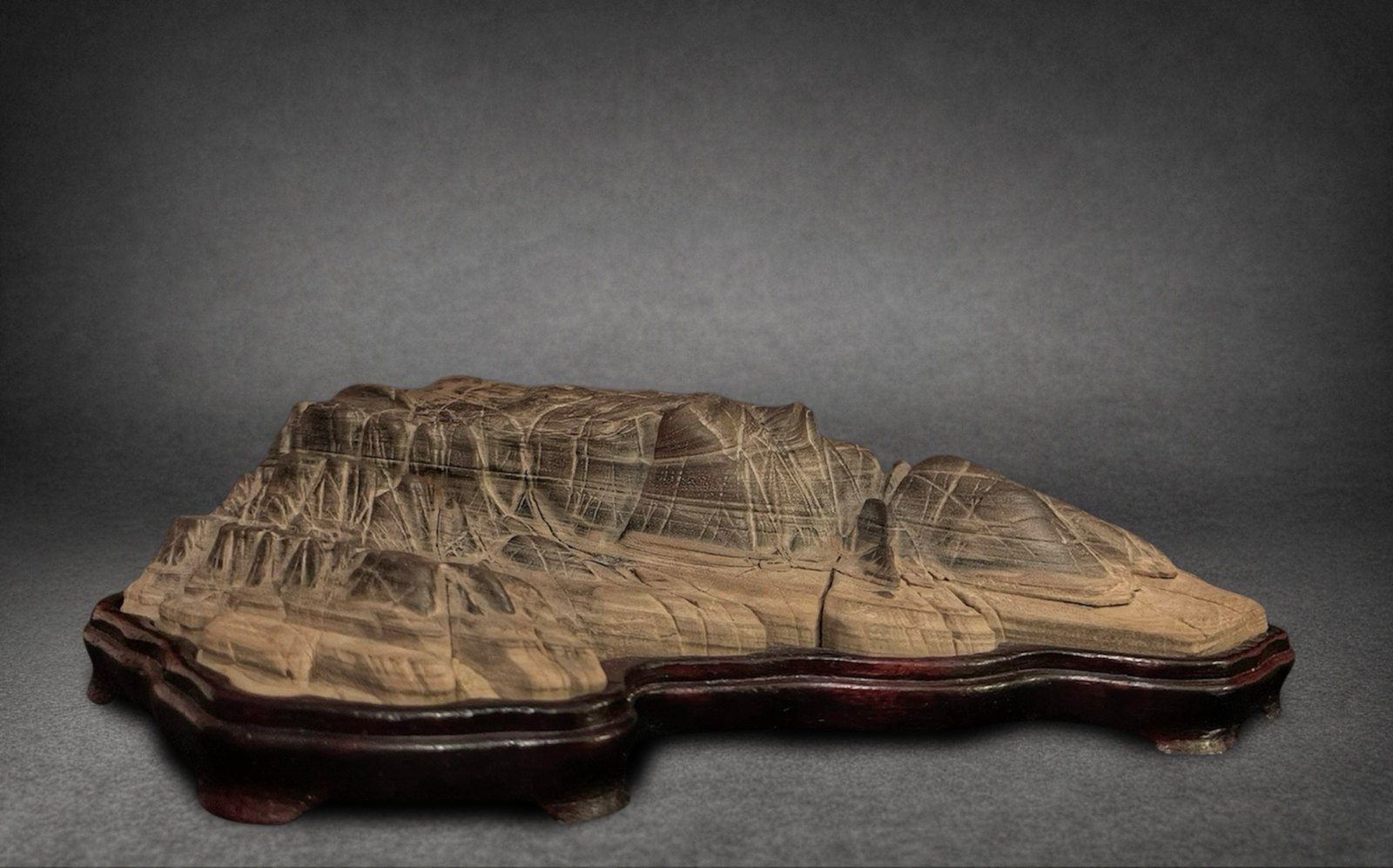
Photograph 22. Restrained Movement and Visual Exit An ancient, deeply eroded landscape whose worn formations and sediment deposits at their bases evoke an arid or semi-desert environment. The eye settles first on the main elevations and then descends toward the accumulated sediments. The overall slope guides the gaze to the right, providing a natural visual exit, and this uninterrupted movement lends the stone calm and serenity.
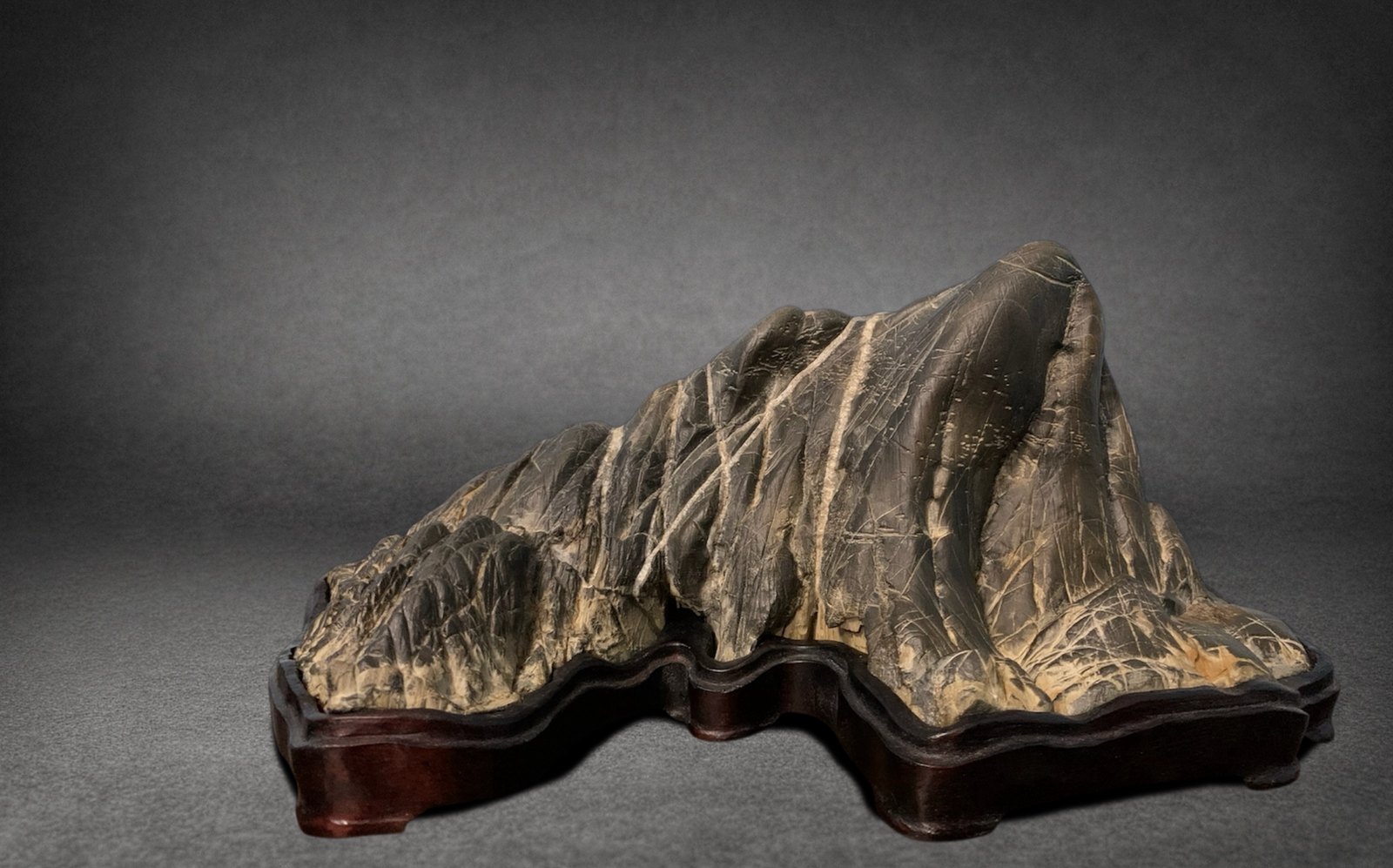
Photograph 23. Movement and Direction of the Gaze The main peak rises in a pronounced curve that lends energy and movement to the composition. The eye follows this curve to the right-hand summit, then traces the descending profile to the left, through progressively lower formations, until it finds a natural visual exit. The movement is continuous and restrained: it brings the stone to life without disturbing its serenity.

9. Unity: What Gives the Whole Its Meaning

None of the above works if the qualities accumulate without relation. It is not a matter of gathering disparate reliefs, each on its own, or of the stone being a catalog of oddities. A chaotic piece, however many points of interest it may have, tires and disorients.

Unity is the quality that organizes all the others. When the reliefs relate to one another, when some lead to others, when rhythm, breaks, and changes of height obey a single logic, the stone is perceived as a coherent whole. That coherence translates into harmony and balance, and it is what allows the whole to convey a single idea, a single emotion.

A good check is to ask whether, if any significant part of the stone were mentally removed, the whole would lose coherence, balance, or some of its character. If the answer is yes, there is probably unity.
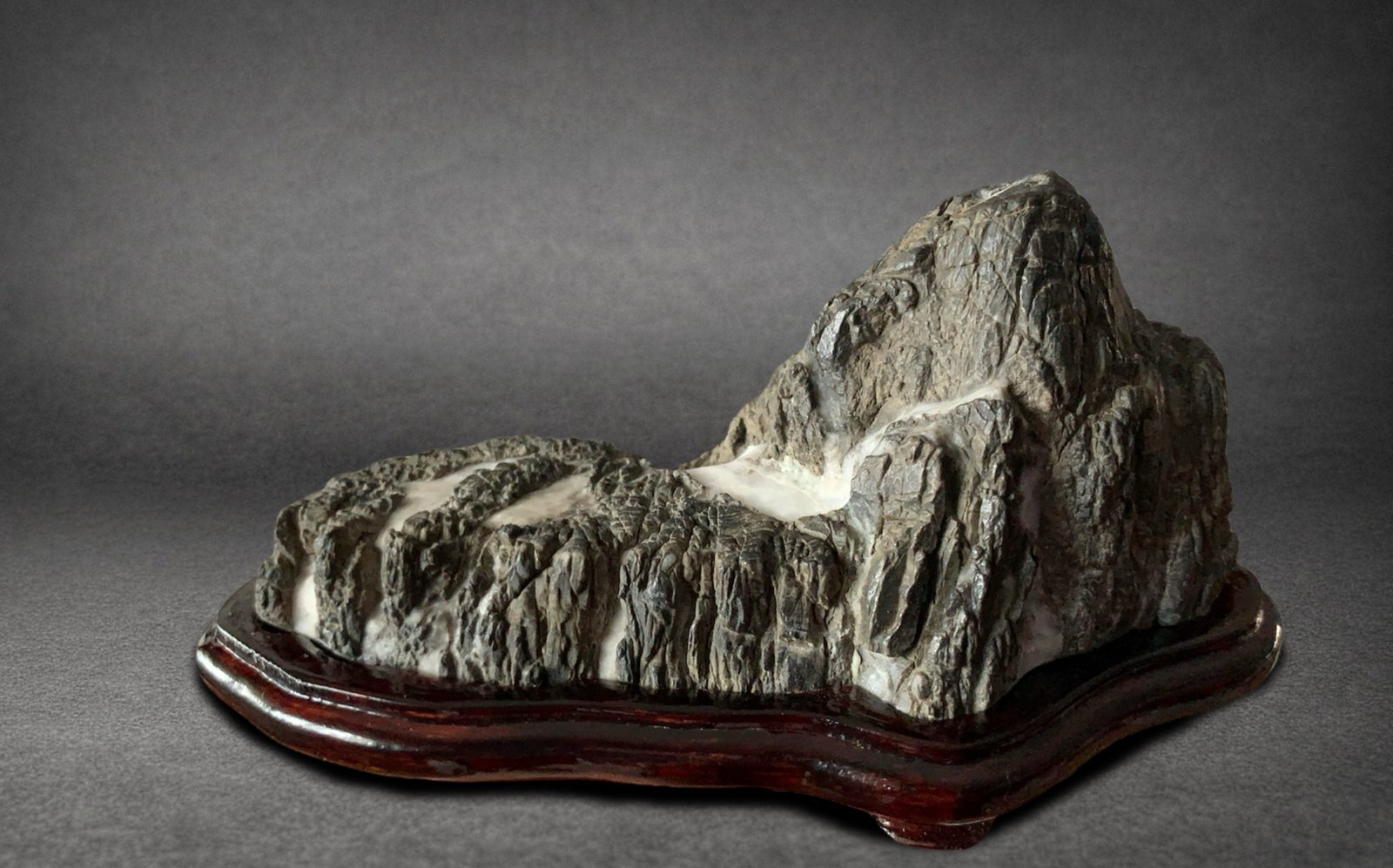
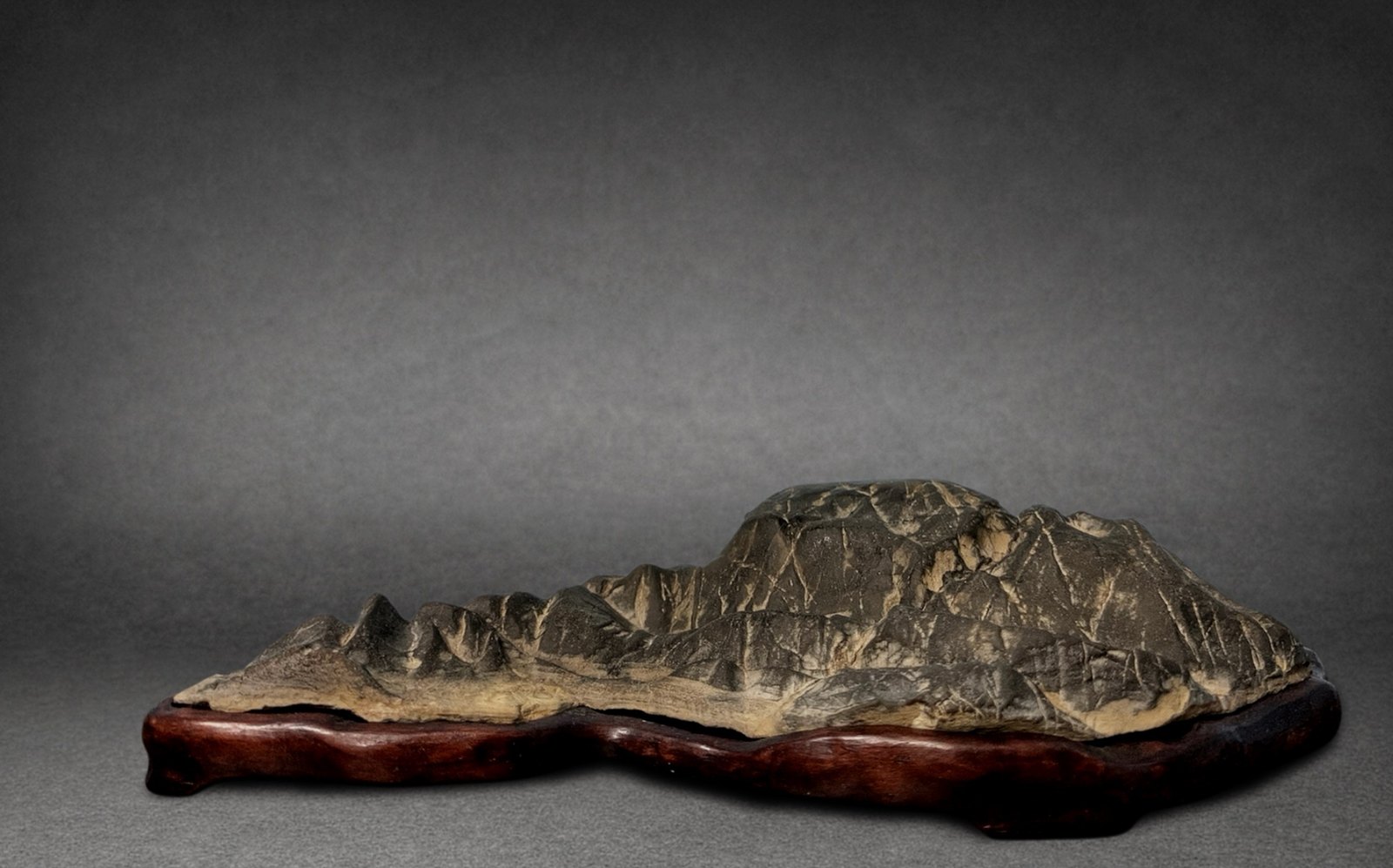
Photograph 24. Unity, Focal Point, and Asymmetry The stone evokes a landscape in which a high peak appears to feed a waterfall that descends into a depression halfway down, where the water gathers into a small lake. All the elements belong to the same scene and relate coherently to one another: unity arises not from repetition but from the contribution of each formation to a single interpretation of the landscape. The asymmetrical arrangement reinforces its natural character.
Photograph 25. Unity, Diversity, and Erosion A small stone, barely 17–18 centimeters (about 7 inches) long, that evokes a mountain landscape on a much larger scale. Its upper formations are rounded and heavily weathered, in contrast to the lower, sharper elevations on the left. This diversity of forms and degrees of erosion is integrated through gradual transitions that preserve the unity of the composition.
Photograph 26. Unity, Diversity, and Asymmetrical Balance An extensive mountain range combining formations of different ages and degrees of erosion: heavily weathered elevations, slopes, and valleys alongside peaks that retain sharper profiles. This diversity creates visual richness, while the grayish tone unifies the distant landscape. The most prominent elevations occupy the outer areas rather than the center: the left side rises higher, and the profile descends gradually to the right, guiding the eye toward its natural exit.
Photograph 27. Unity, Asymmetry, and Rhythm A sandstone whose main strength lies in the repetition of lobed forms, shaped by erosion in a similar but never identical way. The main elevation sits slightly right of center, and the slopes on either side follow different inclinations, avoiding symmetry. Each lobe keeps its own character: some are broader, others more rounded, and a few preserve slightly sharper profiles. This repetition with variation creates rhythm and, above all, strong formal unity.

10. Color

Color has no absolute aesthetic value: it depends on what the stone represents. And the rule that governs it is not invented but observed in nature.

Anyone who gazes at a distant landscape finds that, as distance increases, colors lose intensity and contrast and turn grayish or bluish. A slope that up close we see as green, ochre, or even white appears gray from afar. The cause is the atmosphere: particles in the air scatter light and veil what lies behind. Painters have known this for centuries as atmospheric perspective or aerial perspective, and Leonardo da Vinci already described it: distant objects appear less saturated, with less contrast, cooler, and with less detail.

Clear consequences follow from this for suiseki:

A stone that evokes a distant landscape (a faraway mountain, for example). It should have a muted color, in gray, bluish, or neutral tones, sober, with low saturation and low contrast. An excessively vivid, warm, or contrasting color contradicts the sense of distance: the stone ceases to be believable as a distant mountain. To this is added a preference of the Japanese tradition, which especially appreciates very dark stones for their ability to evoke distant mountains and valleys.

A stone that conveys nearness, as if we were viewing the landscape from a short distance. It admits, and almost demands, greater variation of color: nuances, veining, contrasts, and warmer tones, because up close color is perceived in all its richness.

A stone that does not represent a landscape (a figure, an animal, an object). Its color should suit what it evokes and the way that subject would appear in nature.

The criterion, in all three cases, is the same: the color of the stone should be the color the subject would have if we viewed it in reality, at the distance from which the stone invites us to see it.
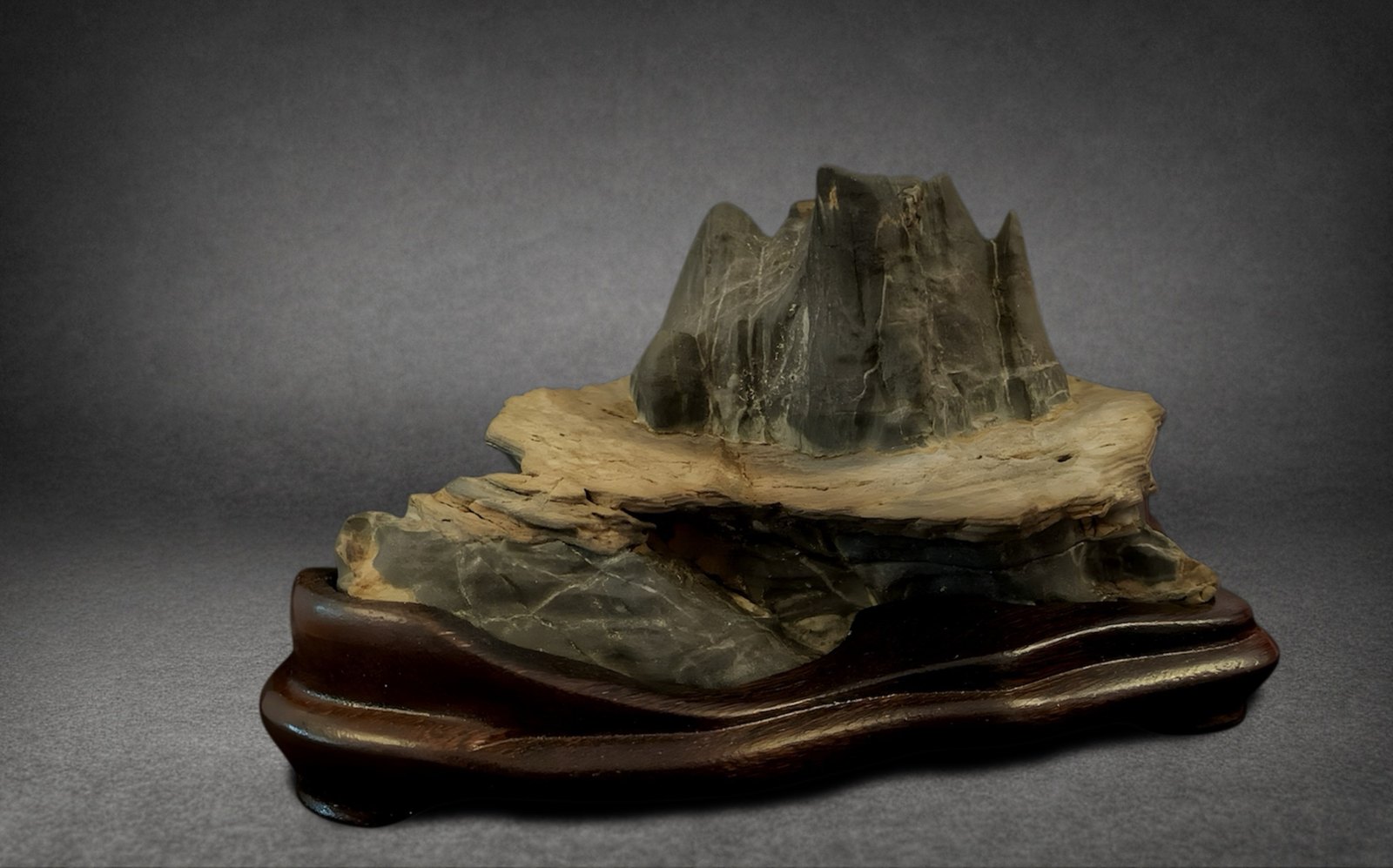

Photograph 28. Atmospheric Perspective and Texture A towering mountain that seems to rise above a layer of low clouds. The scale of the landscape suggests a distant viewpoint, and the smooth, understated surfaces, with few details or rough textures to interrupt the reading of the relief, agree with that impression. Texture thus contributes to the perception of distance and vastness.
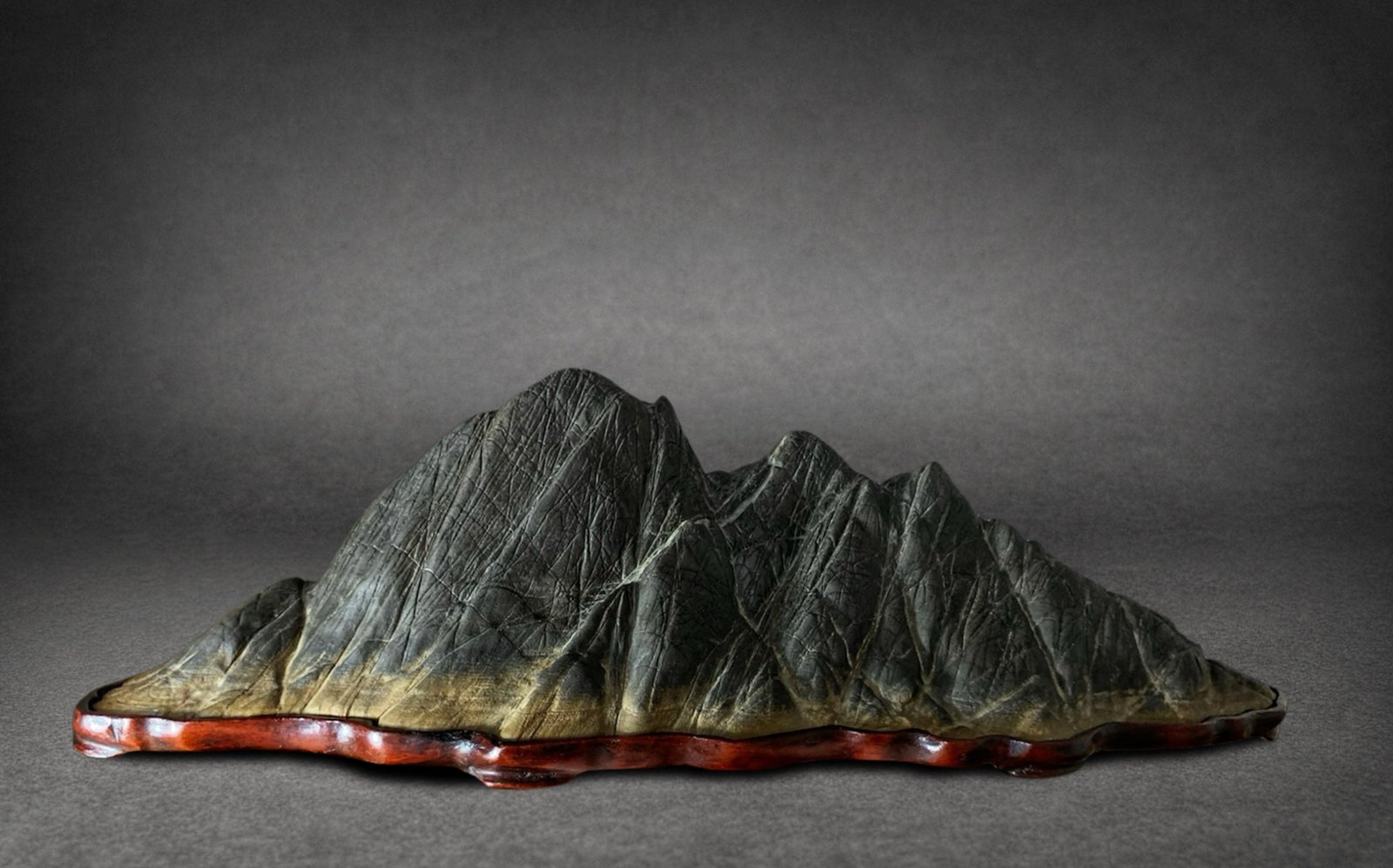
Photograph 29. Color, Texture, and Atmospheric Perspective This stone evokes an extensive mountain range seen from a great distance. Its formations recede through successive planes, with some summits appearing snow-covered while others rise above them. The dark gray color and softened surface agree with the impression of distance, recreating the loss of chromatic intensity and detail characteristic of atmospheric perspective.
Photograph 30. Atmospheric Perspective, Asymmetry, and Movement A distant-landscape stone with a sharp, apparently younger peak beside a much more rounded and weathered elevation, perhaps the remnant of a once higher mountain. Their asymmetrical arrangement avoids predictability and contrasts different stages of erosion. A moderate slope connects the two and guides the eye toward the lower ground. The smooth surface and grayish tone reinforce the impression of distance and age.

11. Texture

Texture obeys the same principle. When we observe a landscape up close, we clearly perceive the irregularities of the terrain: the grain, the roughness, the cracks, the small projections. At a distance, however, those details are lost: the eye no longer distinguishes them, and surfaces soften, dissolve, and blur.

The stone should behave in the same way:

A stone that evokes a distant landscape should present a visually smoother, more continuous texture, in which small reliefs blur in the perception of the whole. A very rough, detailed texture would “bring it closer” and break the illusion of distance.

A stone that evokes a nearby landscape should show a texture and roughness to match, allowing that relief to be perceived just as we would perceive it standing beside the real landscape.

In stones that do not represent landscapes, the texture is again adjusted to what they evoke.

Only when color and texture agree with each other, and with the depth and scale of the suggested landscape, is the stone convincing. A distant mountain with vivid color and a rough surface, or a nearby landscape in muted tones and with a smooth texture, send contradictory messages, and that contradiction breaks the unity of the whole.

It is not a matter, therefore, of inventing or imagining anything. The law that governs color, texture, and, at bottom, everything above is the contemplation of nature: observing how things are perceived in the real landscape and seeking to have the same happen in the stone.
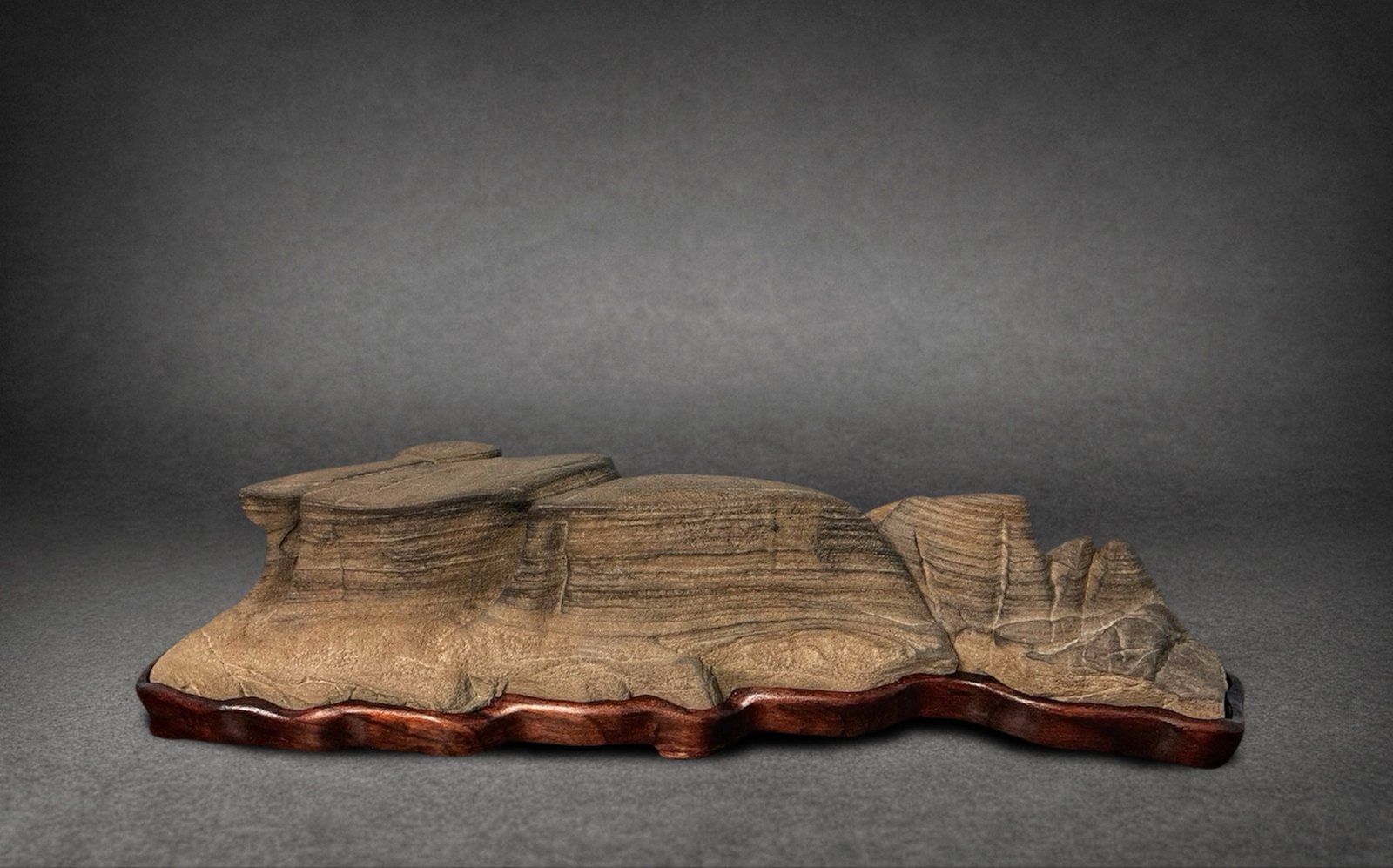
Photograph 31. Erosion, Rhythm, and Movement A sandstone evoking a deeply eroded semi-desert landscape, its longitudinal strata still clearly visible. A broad, ancient formation with an almost flat, tabular summit contrasts with the sharper elevations on the left, which seem to represent a less advanced stage of erosion; this contrast prevents monotony and enriches the landscape. The eye settles first on the broad formation and then follows the descending reliefs to the right, where the younger peaks gradually lose height and provide a natural visual exit.

12. Reading the Character of the Stone

Beyond the qualities above, every stone has a character, a visual force of its own. Learning to read it is essential, both for appreciating the stone and for presenting it.

A stone with a rough surface, heavy mass, dark color, firm edges, and robust presence conveys a character we might call masculine, formal and severe. A stone with a smooth surface, delicate forms, light masses, and flowing lines conveys a feminine character, more informal and elegant. Between the two extremes lies a whole range, and many stones combine traits of both. What matters is recognizing which way each one leans. These are conventional aesthetic categories, not objective attributes of the stone; one could equally speak of robust and severe versus delicate and elegant.

This reading determines how the stone should be accompanied. And it leads directly to the daiza.

13. The Daiza in Service of the Stone

I do not attempt here an exhaustive study of daiza aesthetics, for which other works exist, but rather to underscore a principle: the daiza must answer to the character of the stone it supports.

One often sees craftsmen adopt a model they are comfortable with and reproduce it for every stone. This is understandable, and the result may be technically impeccable, but it is not entirely right. Each stone asks for something different, and the ideal daiza is born of attentively reading the piece’s characteristics: its form, its visual force, its character, its dynamism.

Some guiding criteria:

A masculine, heavy, formal stone. It calls for a sober daiza, with straight, firm lines and robust legs that visually bear its weight and anchor it securely.

A dynamic stone. It calls for a daiza with more curved or softened lines and legs that contribute movement, that do not tie the stone to the ground too rigidly. An excessively static daiza would cancel the energy the stone conveys.

An elegant, feminine stone. It calls for soft, light lines that align with the forms of the stone itself and continue them rather than compete with them.

Two details from stones shown earlier illustrate the contrast. In the first, a heavy, formal stone rests on a daiza with a raised rim and sturdy legs; in the second, a smooth, softly modeled stone is accompanied by a slender daiza whose curved outline and delicate legs follow its lines.
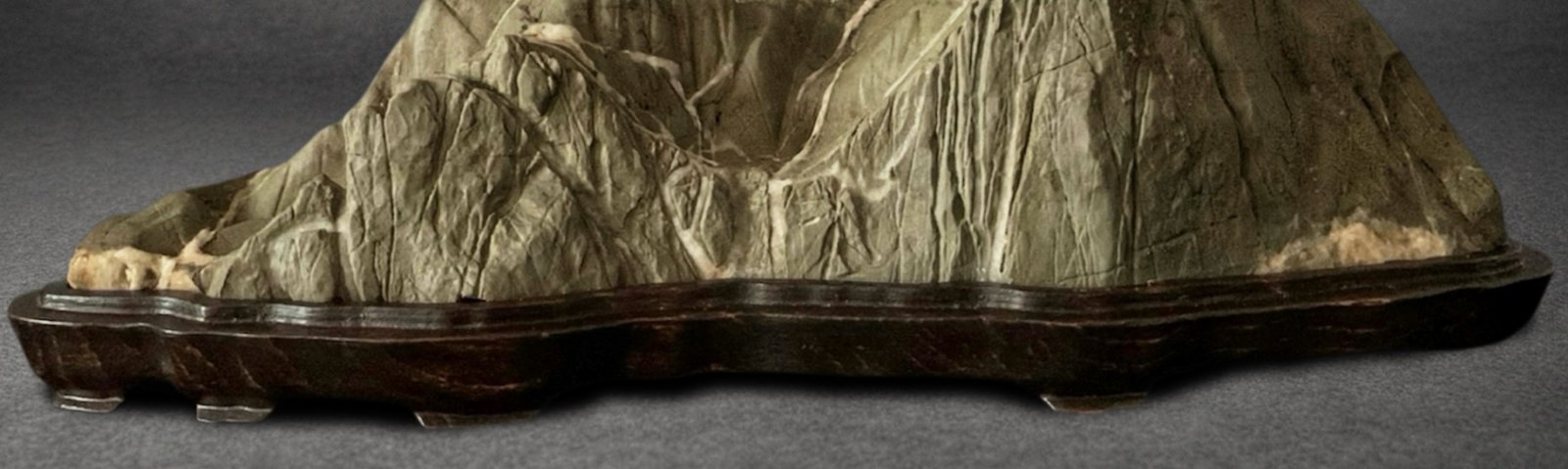
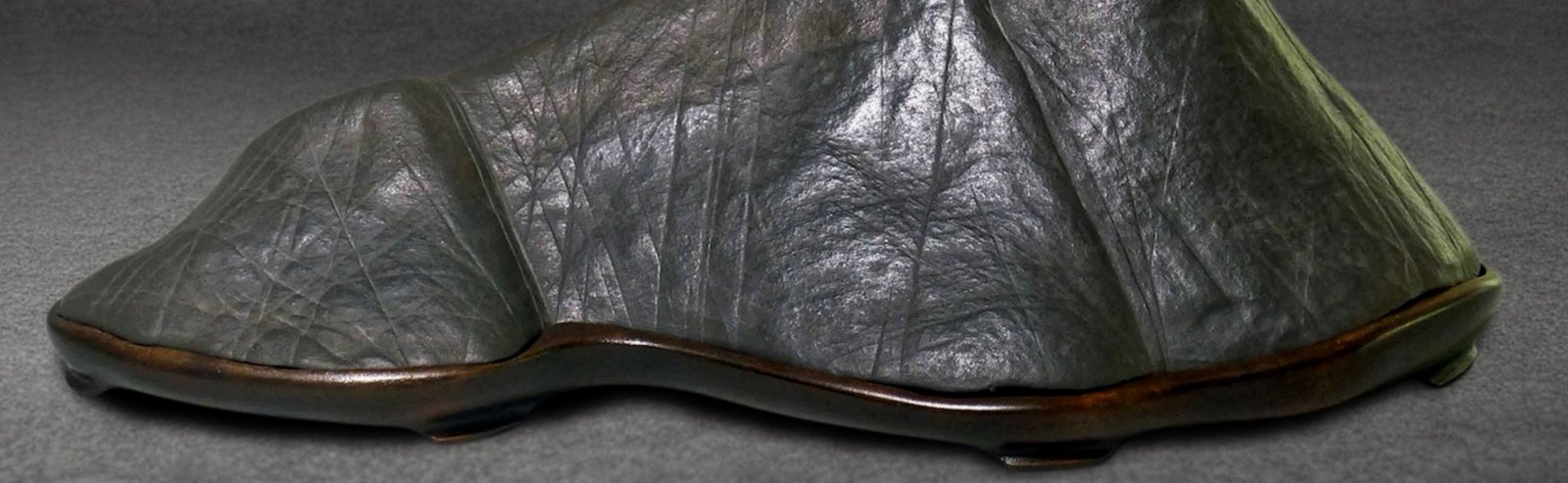
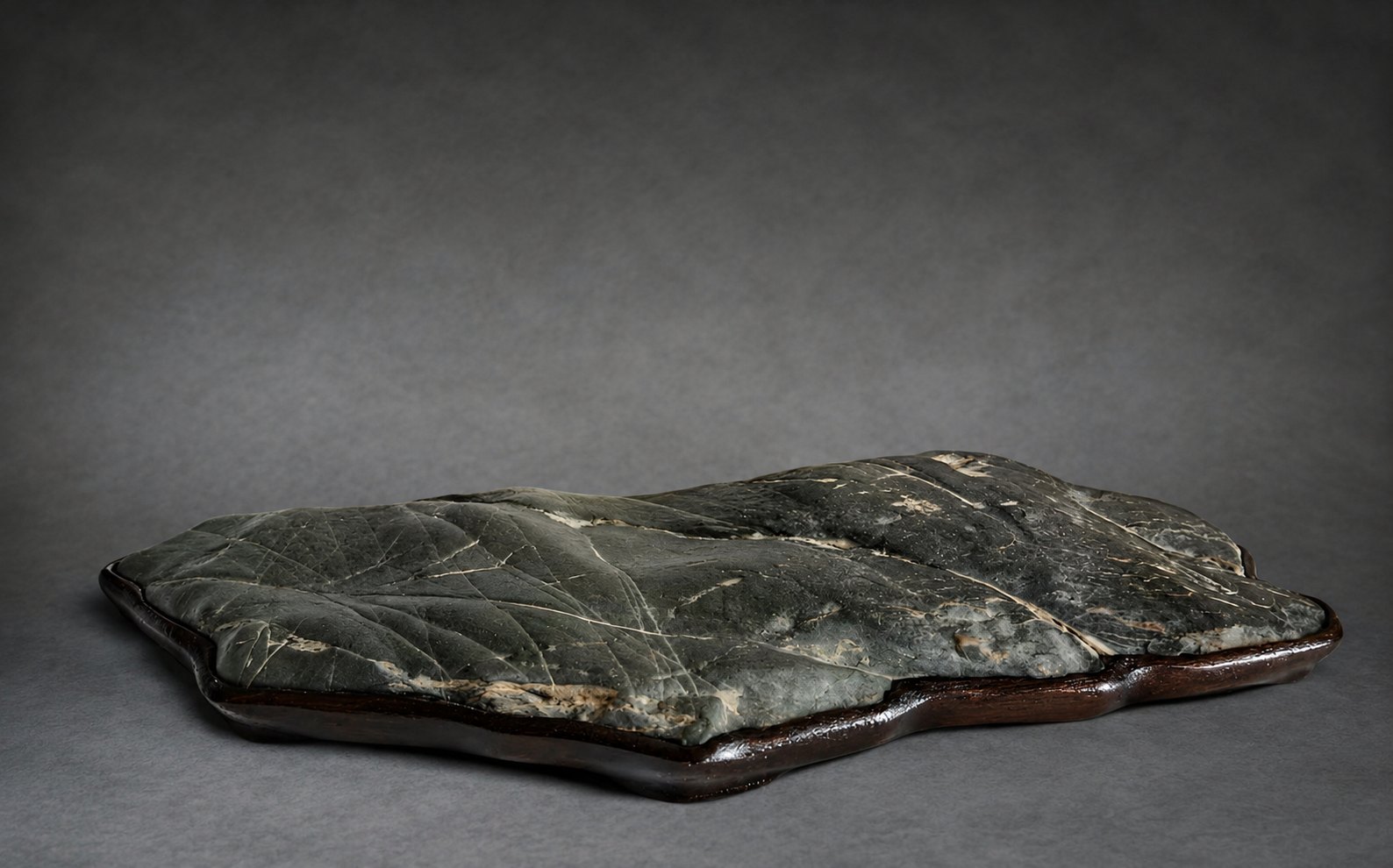
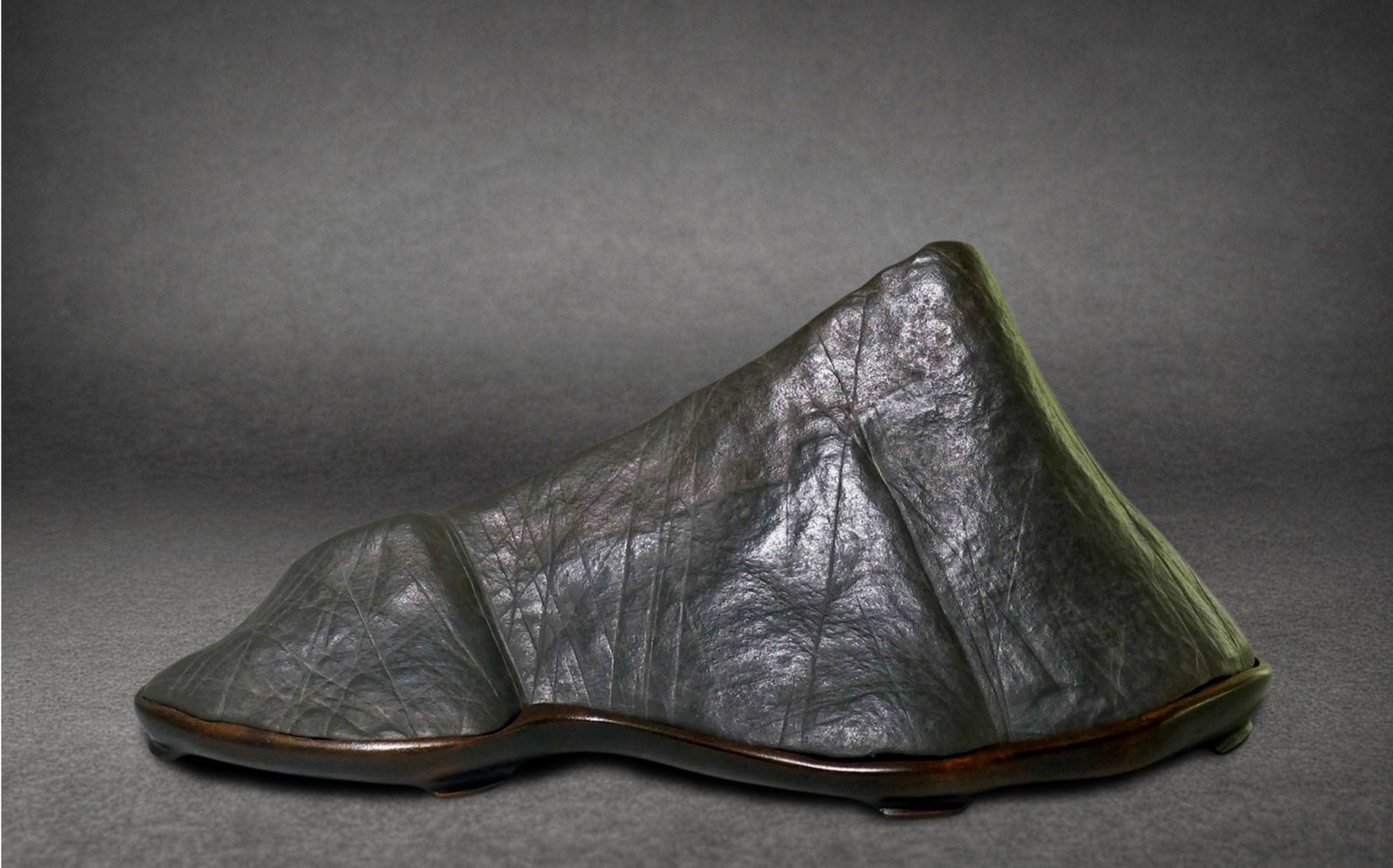
Photograph 32. A Formal, Robust Daiza Detail of Photograph 3. The thick, dark wood, the raised rim, and the sturdy legs give a firm, grounded base to a stone of weight and formal character, whose valleys descend toward a central depression.
Photograph 33. A Light, Flowing Daiza Detail of Photograph 30. The thin wood, the gently curved outline, and the delicate legs follow the soft contours of this polished stone and continue them rather than compete with them, giving it a light and graceful presence.

The same logic applies to decoration, to the shape of the legs, to the amount of surface in contact with the ground, and therefore to the degree of stability one wishes to convey. In every case, the daiza should accompany without eclipsing: if it draws more attention than the stone, it has failed. And its greater formal regularity should serve as a frame that, by contrast, sets off the natural irregularity of the stone.

14. Proportion and the Fibonacci Spiral

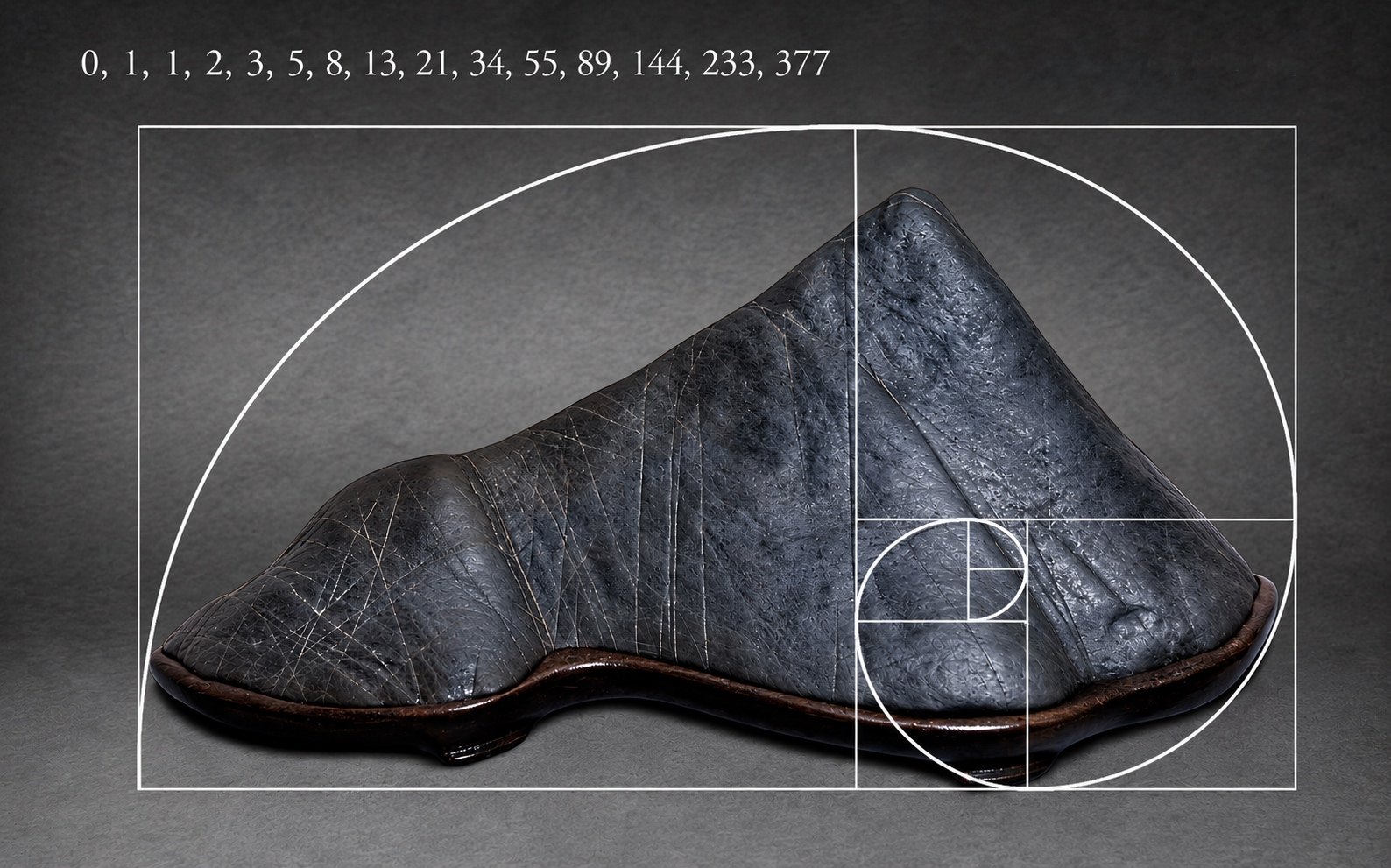
Behind all of these qualities lies something older and more general: proportion. In the thirteenth century the Italian mathematician Leonardo of Pisa, known as Fibonacci, introduced to Europe the sequence that bears his name, in which each number is the sum of the two before it: 1, 1, 2, 3, 5, 8, 13, 21, and so on. The ratio between consecutive numbers settles ever closer to 1.618, the golden ratio, and the spiral built from squares of those sizes has long been used to describe the proportions that the eye finds natural and harmonious. Echoes of it appear in the arrangement of seeds in a sunflower and in the scales of a pine cone, and it has often been invoked by painters, architects, and designers seeking a balance that does not look constructed.

The idea is simple to visualize. Take a rectangle in that proportion, divide it into a large square and a smaller rectangle, and repeat the process within each remainder; a spiral then winds through the squares toward a single point. Laid over a suiseki, the spiral works as a test of proportion rather than as a rule: if the mass of the stone, the position of its summit, and the descent of its flanks follow that curve, its parts relate to one another as the parts of the spiral do.

Photograph 34. Proportion and the Fibonacci Spiral Superimposed on the stone’s silhouette, the spiral shows how closely its proportions follow the Fibonacci sequence: its mass, its summit, and its descending flank follow the curve very closely. This agreement helps explain the serenity, elegance, and natural harmony the stone conveys.

That is what the stone in Photograph 34 shows. When the spiral is placed over it, the fit is remarkably close, and the different elements of the stone appear structured, related, and closely accommodated within the proportions the spiral describes. I would not claim that this is the only reason it moves us, nor that every fine stone must obey the spiral; many do not, and their beauty lies elsewhere. But it is hard to ignore that a stone of such serenity, elegance, and beauty is also one whose proportions come so close to the ideal. The eye registers that harmony before the mind can explain it, and it is, in the end, what all the qualities discussed in this article try to name in different words.

Conclusion

A stone is not beautiful merely because nature created it. It is beautiful when our eyes find in it a set of qualities that human beings have always perceived as attractive: a clear focal point, depth, asymmetry, rhythm, breaks, well-defined voids, balance, a sensation of movement, harmonious proportions, color and texture consistent with what the stone evokes, and, above all, a unity that makes them form a whole. The better these qualities manifest themselves and relate to one another, the greater the visual quality of the piece, and the more justified we will be in recognizing its aesthetic excellence.

Appreciating a suiseki, then, goes well beyond recognizing a natural form in it. It means learning to observe how its volumes, voids, rhythms, and balances relate to one another, and how each detail contributes to the harmony of the whole. A stone may be remarkable for its origin or its shape, but its true aesthetic expression lies in the relationship among its qualities. This way of seeing does not replace a piece’s history or provenance; it adds to them, and it is within reach of any attentive observer. To learn to look is, in the end, to discover the beauty that nature has left in the stone.
Further Reading
Further Reading

Arnheim, Rudolf. Art and Visual Perception: A Psychology of the Creative Eye. New Version. Berkeley: University of California Press, 1974.

Arnheim, Rudolf. The Power of the Center: A Study of Composition in the Visual Arts. Berkeley: University of California Press, 1982.

Covello, Vincent T., and Yuji Yoshimura. The Japanese Art of Stone Appreciation: Suiseki and Its Use with Bonsai. Rutland, VT: Charles E. Tuttle, 1984.

Dondis, Donis A. A Primer of Visual Literacy. Cambridge, MA: MIT Press, 1973.

Leonardo da Vinci. Treatise on Painting. Translated by A. Philip McMahon. 2 vols. Princeton, NJ: Princeton University Press, 1956.

About the Author

勝譲謙 (Masaru Ken) is a bonsai and suiseki master and a practitioner of the Keidō Katayama-ryū tradition, as well as an official disciple within that lineage through the third Iemoto, Kobayashi Kunio (Ippū). During his autumn 2026 stay, he received this artistic name from his teacher, in which Ken (謙) means humility. His general name remains 勝譲武古 (Masaru Buko).

He is an instructor affiliated with ABE, BCI, and World Bonsai University, and has been an International Bonsai and Suiseki Instructor for BCI since July 2026. He directs the Escuela Tradicional Sagunt-En (Sagunt-En Traditional School) in Toledo, Spain. His training also draws on ornithology and physical geography, and he maintains an extensive personal collection of bonsai and suiseki stones.

Compartir:

761 visualizaciones

Bonsai Clubs International — Important Notice

BCI 2026 Convention — Cancelled & Postponed

Status: Cancelled & postponed — until further notice

Bonsai Clubs International has been formally notified by the host, the Malaysian Penjing Art Creation Society (MPACS), that the BCI 2026 International Convention in Kuala Lumpur, Malaysia — originally scheduled for 19–23 June 2026 — has been cancelled and postponed until further notice due to unforeseen circumstances, including the ongoing global fuel crisis and the withdrawal of anticipated funding and financial support.

This is a postponement, not a retreat from our shared commitment. Revised dates and arrangements will be announced through official BCI channels once conditions allow and preparations are confirmed. We sincerely appreciate your understanding and continued support.

⬇ Download the full official resolution (PDF)

You must choose one of the options above to continue to the site.

Utilizamos cookies para mejorar su experiencia. Al continuar utilizando este sitio, usted acepta nuestro uso de cookies.

Soporte