|
Serissa - Serissa foetida
General information:
These small shrubs are much loved as bonsai for their tiny
flowers which may occur 2-3 times yearly, gnarled trunks, and
naturally miniature leaves. Most bonsai are S. foetida, of which
many cultivars are available.
Probably the two most common bonsai purchased
by the casual bonsai buyer in America are Juniperus and Serissa.
Judging from the number of junked junipers and shriveled Serissas,
beginners would be far happier with elm and Ficus. Serissa is
a notoriously fussy bonsai. The good news is that they aren't
that hard to keep alive. But considering that most people buy
Serissa on impulse because the plant is so spectacular at the
store, the bad news is bad indeed. The plant will generally drop
its flowers within a day or two. Then the plant will drop its
leaves. If the grower doesn't panic (and many Serissas are inadvertantly
killed by panicing beginners who respond by drastically over/underwatering
the plant) the plant will soon regrow its leaves. A power struggle
then ensues. The grower soon discovers that the Serissa drops
its leaves if it has too much water. Too little water. If it's
too hot or too cold. If it's moved, or there is a shift in lighting
or temperature.
Lighting: Partial
sun for S. foetida, full sun for S. crassiramea. If kept indoors,
needs 1000 Lux. Use of grow lamps for 12 hours daily is beneficial.
Too little light will result in leggy growth.
Temperature: Hardy
to zone 9. Some growers bring them in when temps drop to 50F,
others leave them outside until temps are in the 20s! Ideal winter
temperatures range from 50-68F. More important than the actual
temperature seems to be two factors: the plant dislikes a sudden
change in lighting (many die from lack of light when brought
indoors) and individual plants may be show different hardinesses
(a Serissa grown outdoors from youth will withstand a greater
variation in temperature than a Serissa purchased from a greenhouse).
If brought indoors, do not position this plant near a heat source,
or it will lose leaves. If kept outdoors year round, will drop
leaves as the temperatures become colder.
Watering:
Keep evenly moist. It generally needs lots of water during warm
weather, so much that some authorities recommend placing the
Serissa in a tray of water. Others warn against this, as it encourages
root rot. Serissa is not a natural water-lover like bald cypress,
so a water tray should not be necessary if you faithfully water
at the first sign of dryness. However, if Serissa dries out,
it will soon drop its leaves. If this occurs, remember to reduce
watering until the leaves return, or root rot may ensue. Some
recommend misting in dry weather. Some recommend daily misting,
but do not mist while in bloom as this causes the flowers to
rot. Placing the Serissa on a moisture tray is another option.
Feeding:
Every 10-14 days during growth, every 4-6 weeks in winter, using
liquid bonsai food or half-strength plant food. Likes slightly
acid soil condiditions, so the occasional application of Miracid
is appreciated.
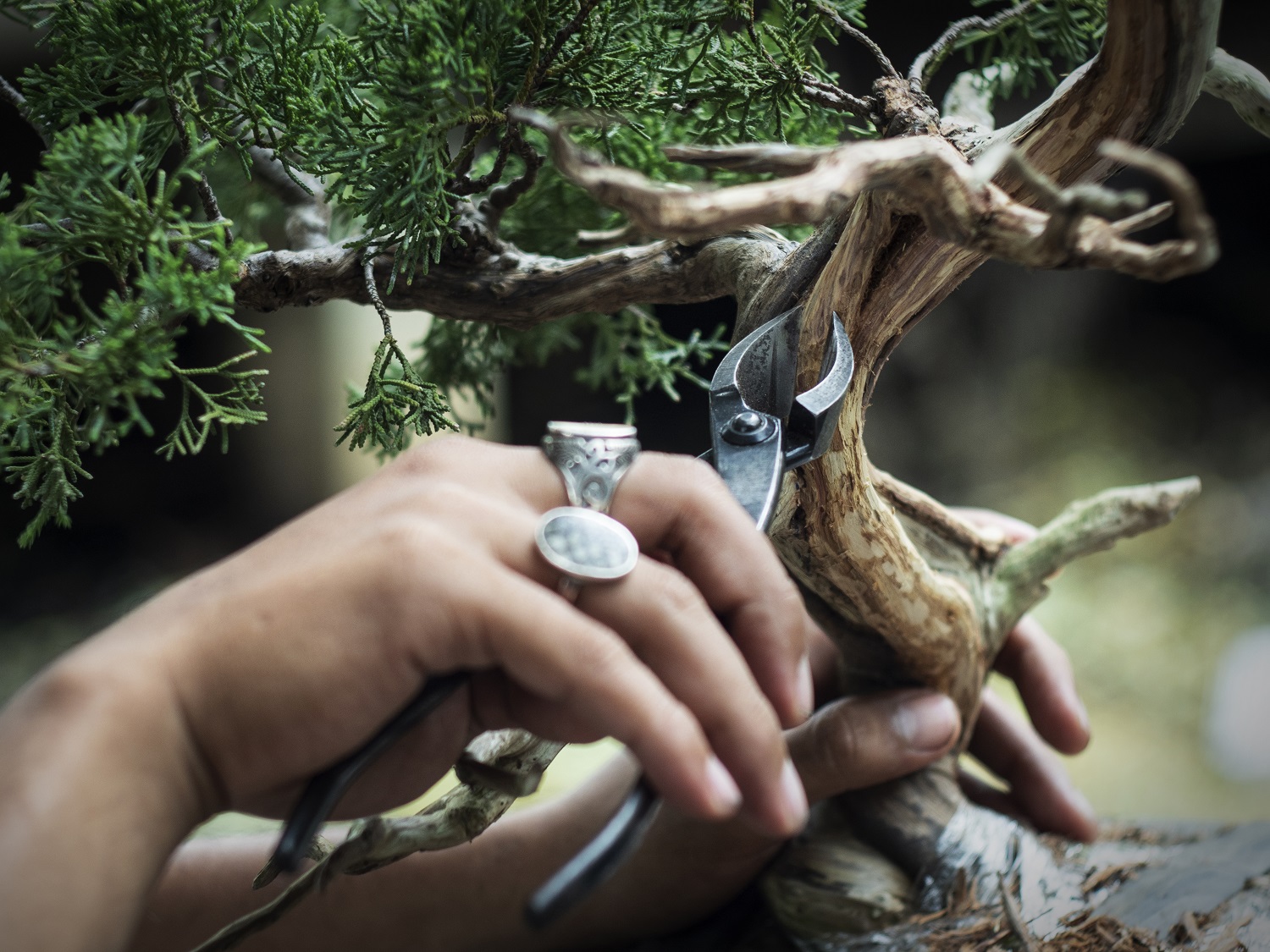
Pruning and wiring: When in bloom, remove fading flowers to encourage
further flower production. Prune as needed; the Serissa is a
fast grower and may need radical or repeated pruning to maintain
its shape. Will bud back on old wood; in fact, some books recommend
occasionally pruning back beyond old growth to help the plant
maintain its shape. Wire during the growing period. Serissa will
grow air roots and is often used in exposed root or root over
rock styles. Eliminate unwanted suckers extending from the base.
Suitable for all styles except formal upright and broom. Suitable
for extra small to medium sizes.
Propagation:
Cuttings root quite easily. Lesniewicz recommends using 4 inch
cuttings in a glass of water from early summer on. The Samsons
recommend bottom heat which would probably induce rooting faster.
Repotting:
Every 1-2 years in spring. The newly pruned roots will emit a
wretched odor! Prune roots moderately, and use basic bonsai soil.
Pests and diseases: Red spider mite, scale, wooly aphids, mildew.
Pests are usually not as much of a problem as a sudden change
in conditions such as light, temperature, etc.
Some species suitable for bonsai:
- Serissa crassiramea: Makino serissa -
A broad leaved shrub. It bears white flowers.
- Serissa foetida (also called S. japonica):
tree of a thousand stars, snow rose, June snow - Many cultivars
are available, including single and double flowered varieties.
Emits an unpleasant smell when pruned, hence the name.
- Serissa foetida 'Chinese' - small tubular
white flowers which bloom only sporadically. Light green foliage.
- Serissa foetida 'Flore Pleno' - double
white flowers which are produced throughout the year. Dark green
foliage.
- Serissa foetida 'Kyoto' - a very tiny
dwarf with single white flowers - rarely grows over a foot high.
- Serissa foetida 'Kyoto Variegated' - Just
what it says.
- Serissa foetida 'Mt. Fuji' - This cultivar
has larger leaves and a thicker stem than other Serissas. It
is strongly variegated, with single white flowers. Variegation
changes throughout the year, based on temperature, light and
nutrient content.
- Serissa foetida 'Pink Mountain' - A slow
growing cv. with variegated foliage in winter and single pink
flowers.
- Serissa foetida 'Pink Princess' - Light
pink buds opening to white, tubular flowers.
- Serissa foetida rosea 'Ahiro Pink' - single
pink flowers, variegated foliage.
- Serissa foetida rosea 'Cherry Blossom'
- single pink blossoms, variegated foliage.
- Serissa foetida rosea 'Pink Swan' - single
pink flowers, variegated foliage.
- Serissa foetida rosea 'Tancho' - single
pink flowers, variegated foliage.
- Serissa foetida 'Variegata' -green leaves,
with yellow or cream colored margins.
- Serissa foetida 'White Swan' - single
white flowers, variegated foliage. Reputedly stronger than the
average Serissa, this cv. forms trunks quickly and seems resistant
to the normal Serissa fussiness!
- Serissa foetida 'Yatsubusa' - Very dwarf
cv. with tiny pink and tiny dark green congested foliage.
Compiled by Sabrina Caine
Return to: Index by Botanical
Name or Index by Common Name
|