|
Norfolk Island Pine - Araucaria
heterophylla
Monkey Puzzle Tree - Araucaria araucana
General Information: The Norfolk Island Pine is a large evergreen has
a single upright trunk, tiered branching habit, and a narrow
pyramidal or columnar shape. Eventually reaching a height of
about 80 feet, the tree possesses a rapid growth rate. The tree
would grow taller, but lightning frequently limits height growth
in the eastern U.S. The dark green, 1/2-inch-long, individual
leaves on young trees are lanceolate and look somewhat like spruce
or fir needles at first glance. Mature leaves are somewhat contorted
on twisted branches. Both leaf types appear on the tree at the
same time. The trunk is often curved and swollen at the base
and black. The large, spiny, 10 to 15-pound cones are rare in
cultivation. Male and female cones are usually found on seperate
plants. They are native to South America and some Pacific islands.
The Monkey-Puzzletree, also an Araucaria,
is a large, bizarre evergreen, 60 to 70 feet tall and 30 to 35
feet wide, which forms a loose, see-through, pyramidal shape
with a straight trunk. The tree is so open in habit you could
almost look at it and not see it. The leaves are dark green,
stiff, with sharp needles densely arranged on horizontal, irregular,
upwardly-sweeping branches. Monkey-Puzzletree makes an attractive,
novelty specimen for a large, open yard or commercial landscape.
It is normally planted only as an oddity someplace in the rear
of a landscape out of view from most passers-by but could be
the specimen feature in a large oriental landscape.
Family: Araucariaceae
Lighting:
they prefer full sun but will survive in low light.
Temperature:
The Norfolk Island Pine is hardy in Zones 10 through 11. The
monkey-puzzle tree is hardy in zones 7B through 11, but doesn't
grow well in overly hot areas.
Watering:
Allow the soil to dry out between waterings. Araucaria does not
like damp soil.
Feeding:
the Samsons recommend organic fertilizer in spring and autumn.
My mom feeds hers (houseplant, not bonsai) with ordinary ol'
houseplant food.
Pruning and wiring:
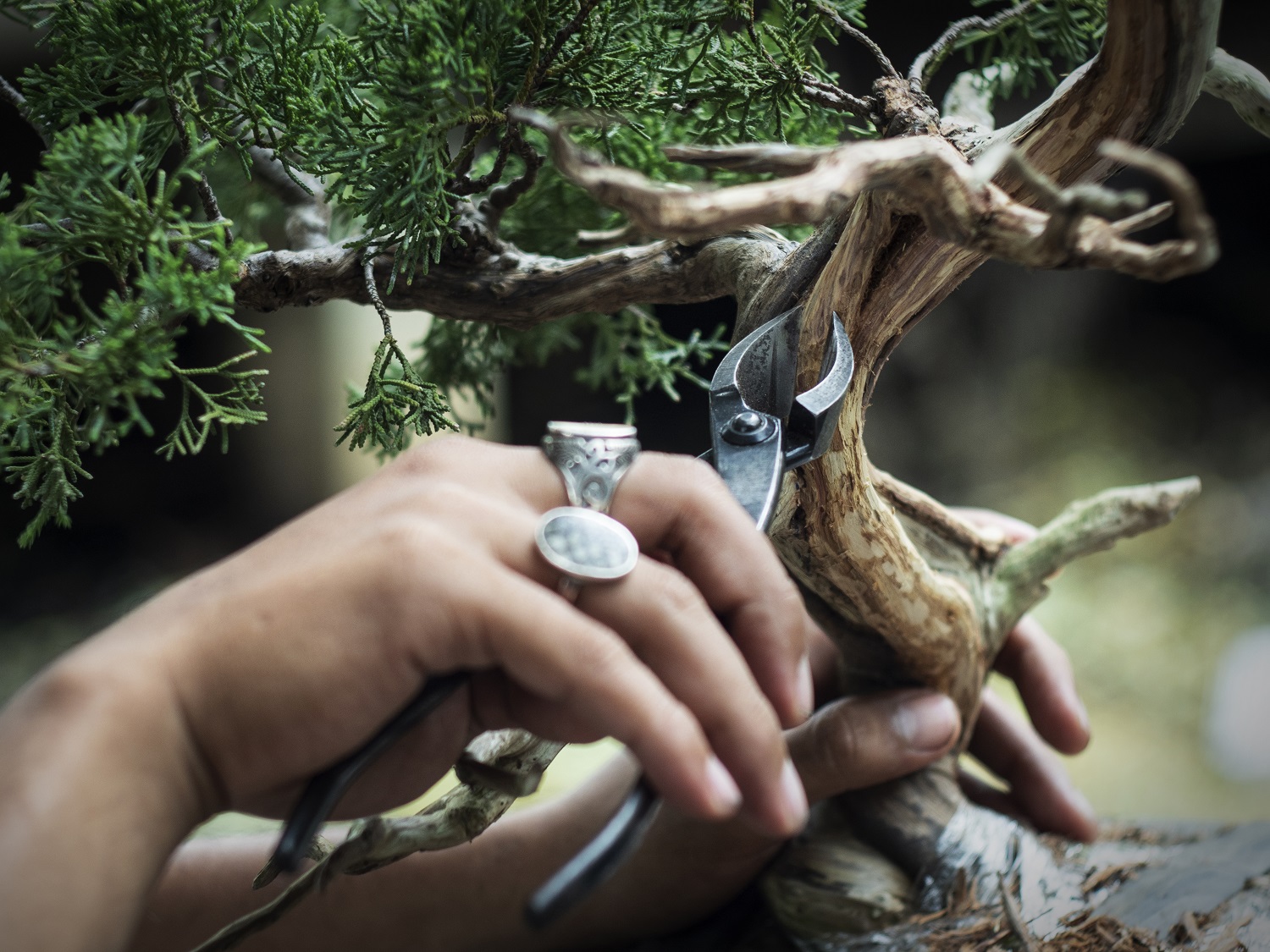
Can be wired at any time, but avoid wiring tender shoots. Wire
should remain on the tree for a maximum of four months. Learning
to prune can be difficult, as Geoline attests:
"These are not easily pruned because
you can't just cut a >frond or tip and expect new growth.
In the spring, only prune new buds just when they are beginning
to emerge and are still light green in color. Remove just the
tip which will include about three soft, needle-like leaves the
same way you would go about bud pruning a Juniper. In a few weeks
to a month, two new buds should take the place of the missing
buds. If you pinch a bud wrong, new growth at the tip will cease.
NIPs are one of those trees which you should practice bud pinching
on several inexpensive practice plants first to develop an eye
for pinching at just the right time."
Araucaria makes especially good cascades,
as they can be trained towards a light source. They also work
as simulated palms.
Propagation:
From seed in spring - germination is slow, and is aided by the
use of bottom heat. Cuttings may be taken from terminal shoots,
not from laterals.
Repotting:
Every second year in spring, using fast-draining soil mix.
Pests and diseases: No pests or diseases are of major concern. Scales,
sooty mold, leaf spots.
Some species suitable for bonsai:
- Araucaria araucana: monkey puzzle tree
- A large, spreading tree, growing to 80 ft. and 30-40 ft. wide.
Has two inch needles and branches which grow in a whorled pattern.
Grows well on the West Coast - it is barely hardy in the Northeast
and suffers from the heat in the South.
- Araucaria heterophylla (also called Araucaria
excelsa): Norfolk Island pine - a common houseplant, often sold
decorated around Christmas! Has a pyramidal shape and short needles.
It is grown outdoors in some areas of Florida and Southern California.
Bibliography:
Lesniewicz's "Bonsai in Your Home"
Samson's "Creative Art of Bonsai"
Mitchell's "American Nature Guides: Trees"
Thomas (ed.) "The Hearst Garden Guide to Trees and Shrubs"
USDA Fact Sheet ST-81 and ST-83.
Compiled by Sabrina Caine
Edited by Thomas L. Zane
Return to: Index by Botanical
Name or Index by Common Name
|